
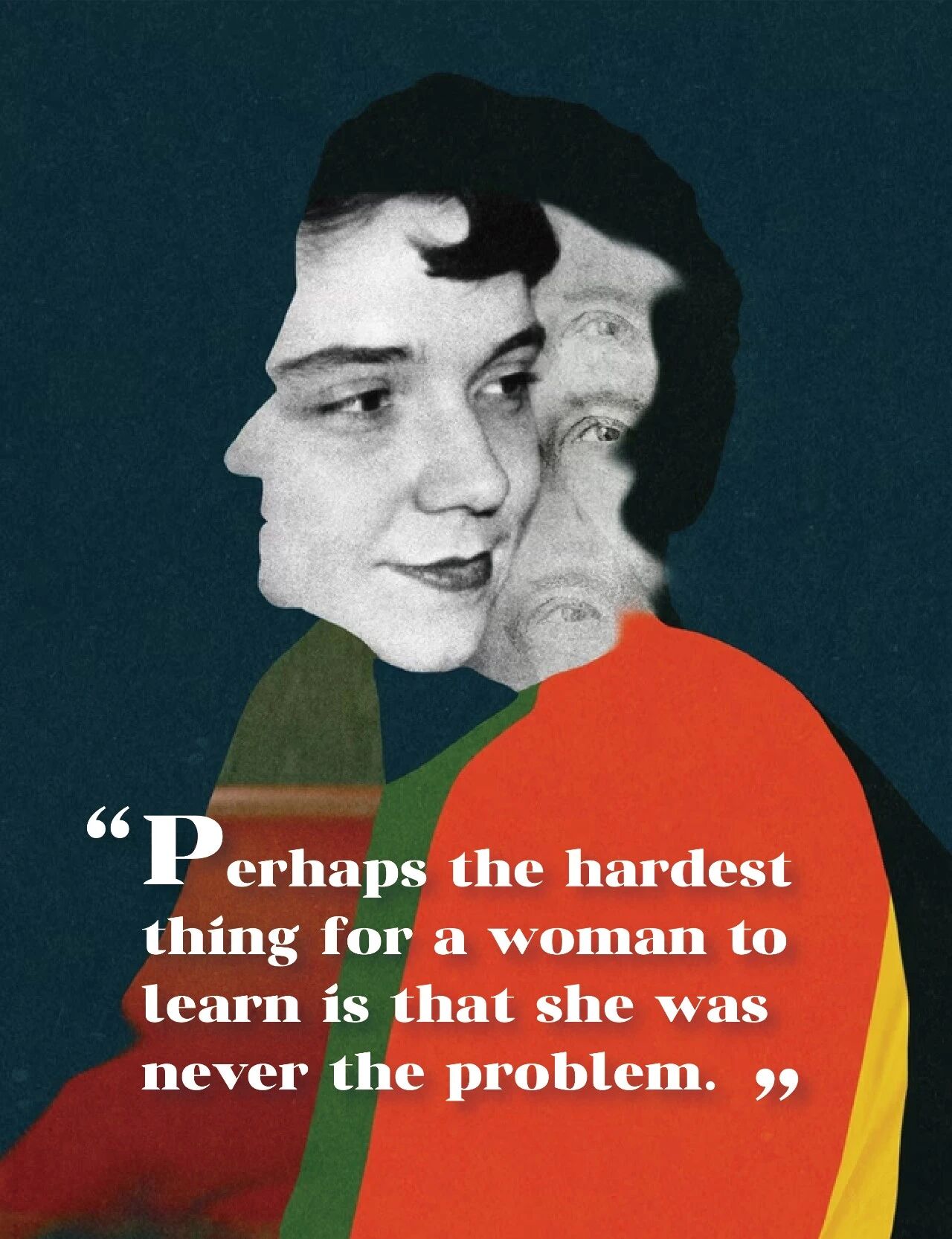
Illustrator by Celina Pereira, used as an illustration in The Atlantic magazine's review of Hillary Holladay's book, The Power of Adrienne Rich.
Within literary history, Adrienne Rich has always resisted singular definition. Poet, feminist thinker, mother, lover—none of these identities alone is sufficient to contain the complexity of a life that was continually unfolding and becoming. Just as no single social role can fully define the existence of women themselves, Rich's life and work remain irreducible to any one designation. By the time of her death in 2012, she had come to be recognised as one of the most influential American poets and public intellectuals of the twentieth century, as well as a lasting cultural figure for generations of feminists, writers, and scholars.
Born in Baltimore in 1929, Rich was raised by a physician father and a concert pianist mother. From an early age, she received a rigorous literary education under her father's guidance. In the 1950s, she became both wife and mother, while simultaneously living through the postwar reconfiguration of women's social roles in the United States. In stark contrast to the Second World War, during which millions of women entered factories and the public workforce, postwar America sought to reconstruct an ideal of domestic femininity centred upon the nuclear family. Women were encouraged—or, more precisely, institutionally and culturally compelled—to return to the kitchen, reclaiming the traditional roles of wife and mother. It was within this historical climate, intertwined with Rich's own lived experience, that Of Woman Born gradually took shape.
Just as the exhibition unfolds across four distinct spatial chapters, Of Woman Born may likewise be understood through four moments of awakening in Adrienne Rich's life. The exhibition is not simply a visual interpretation of Rich's feminist text, but a reconfiguration of its ideas through the lived experiences of both its author and the participating artists. Bringing together six women who are simultaneously artists and mothers, the exhibition invites each of them to respond, through the specificity of their own biographies, to Rich's enduring inquiries into the female body, language, identity, and structures of power. In doing so, the theoretical propositions articulated in Of Woman Born are reactivated across different generations and situated within new historical, social, and personal realities.
The First Awakening:(1929–1953)
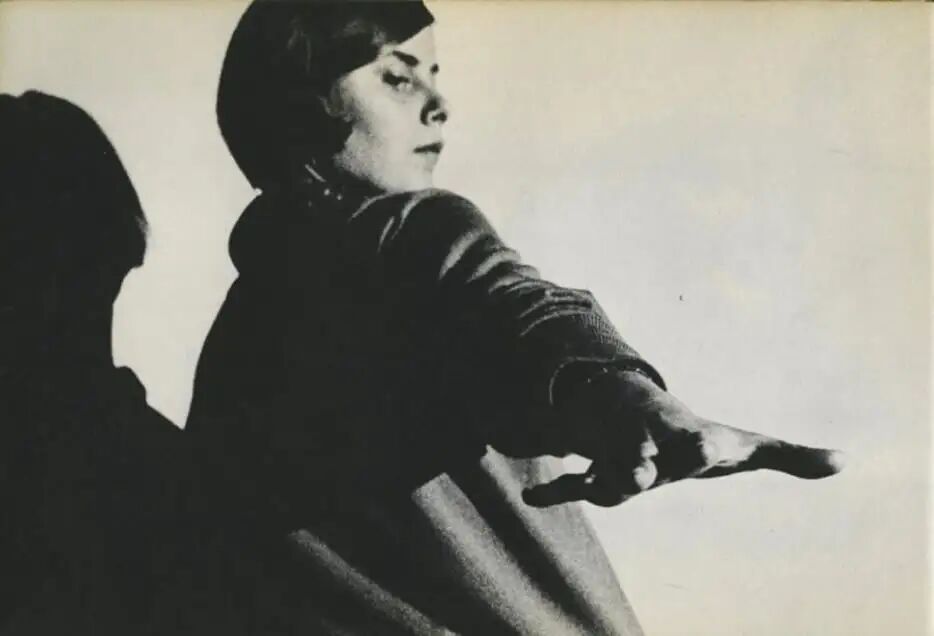
Adrienne Rich, in the1940s
"To become an accomplished woman." This was the future Rich's father envisioned for her. It was also the first site where she encountered the ways in which a patriarchal family shapes the making of a girl—a formative experience that would later become the point of departure for her lifelong inquiry into the social construction of female identity.
As a young woman, Rich studied at Radcliffe College and published her first collection of poetry at the age of twenty-one. Under the influence of her father's education and expectations, she initially believed that talent alone could secure a woman's freedom. Yet over the course of her life, she came to recognise that the image of herself as a literary prodigy had been validated only within standards established by a male-dominated cultural order. Rather than having escaped the structures of gender, the young Rich had, in many ways, become one of their most celebrated exceptions—an exemplary "gifted girl" whose brilliance was affirmed precisely because it remained legible within patriarchal norms.
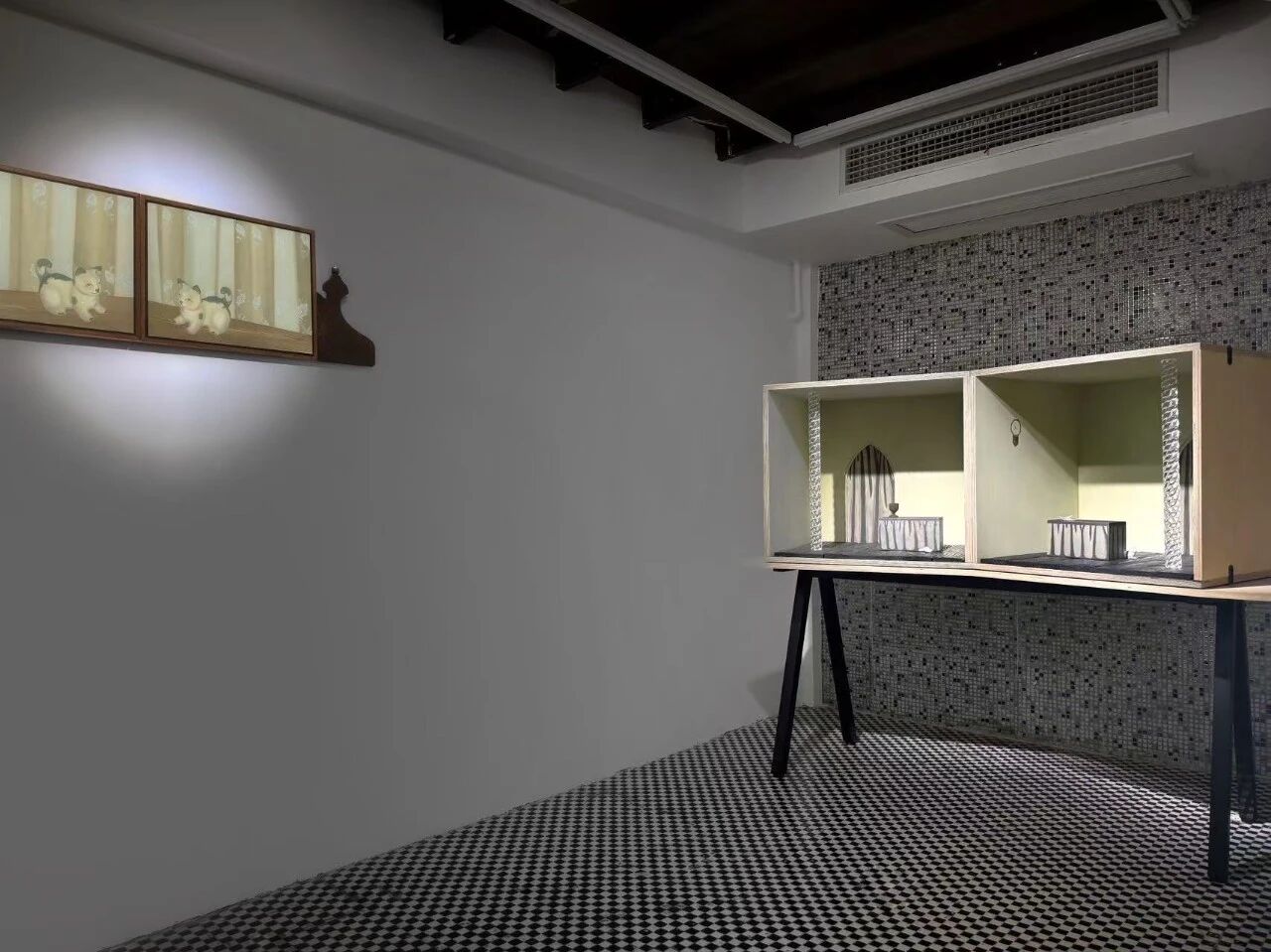
Installation view of Amber Xiangning Lu's artwork, Of Woman Born, Nan Ke Gallery
The exhibition's opening gallery is devoted to Amber Xiangning Lu's evocation of childhood experience and imagined spaces. Familiar elements—toys, bedrooms, and domestic furnishings—come together to construct a realm suspended between reality and imagination. These seemingly intimate and reassuring domestic spaces extend far beyond nostalgic representations of childhood. Instead, they drift between memory, fantasy, and narrative, leaving the experience of growing up perpetually unfinished and resistant to fixed definition. Unresolved (2022) emerged from the artist's research into Gothic literature, particularly the writings of Edgar Allan Poe. Based on a fictional murder narrative devised by the artist, the work unfolds through two symmetrical architectural installations. The interiors of the boxes are rendered using trompe-l'œil, where painted surfaces, physical objects, and scale models converge to create a spatial experience that hovers between the real and the imagined.
If Adrienne Rich considers how a girl gradually comes to understand and inhabit womanhood within the domestic sphere, Amber Xiangning Lu reimagines the home through the familiar form of the dollhouse, transforming it into a theatre of looking, memory, and imagination. These seemingly modest and motionless interiors are more than reflections of childhood; they become an intermediary space where identity quietly takes shape and lived experience begins to accumulate. It is within these small, self-contained worlds that a girl's earliest perceptions of herself and the world are slowly formed.
The Second Awakening (1953–1963)

Adrienne Rich, at her studio, the1950s
In 1953, Adrienne Rich entered what would become one of the defining chapters of her life. That year, she married the economist Alfred Conrad, and between 1955 and 1959 gave birth to three sons. Marriage brought her into the lived reality of motherhood, while the successive experiences of pregnancy, childbirth, breastfeeding, and childcare became the experiential foundation of Of Woman Born. The book's most profound insights emerged not from abstraction, but from the accumulated textures of everyday life—maternal labour, creative frustration, physical exhaustion, solitude, and the relentless demands of care.
Between 1958 and 1963, Rich found herself caught between the identities of writer and mother. She endured prolonged psychological strain, recurring physical illness, and the growing realisation that creative life and domestic responsibility were being cast as fundamentally incompatible. With the publication of Snapshots of a Daughter-in-Law in 1963, a crucial shift in her thinking began to take shape. The conflict she experienced was no longer understood as a personal inadequacy, but as the consequence of a social order that expected women to sustain both artistic creation and motherhood while granting full legitimacy to neither.

Typical 1950s American advertisement on magazine pages
"To become a wife and a mother." This is perhaps the most intimate—and the most painful—chapter of Of Woman Born. Looking back years later, Rich wrote: "I love my children. But I hated the institution that made me a mother." It remains one of the book's most frequently quoted, and most frequently misunderstood, statements.
Rich never rejected motherhood as lived experience. Throughout the book, she repeatedly affirmed her profound love for her three sons. What she questioned instead was the institution that had transformed motherhood into a social obligation: the endless demands of caregiving, the expectation of unconditional self-sacrifice, the erosion of creative time, and the systematic denial of maternal subjectivity. It is here that Rich articulated one of the most influential distinctions in feminist thought: Motherhood as an institution is fundamentally different from mothering as lived experience. What oppresses women is not motherhood itself, but the institution that governs it.

1950s American family, photographed by H. Armstrong Roberts
The exhibition's second chapter evokes the postwar American ideal of domestic life through the image of a suburban backyard. A manicured lawn, freshly washed sheets, flowers in bloom, homemade cakes, and a children's playground together construct the visual grammar of the "ideal" American family. Yet once such images become the very measure of happiness, what remains obscured is the mother's repetitive, invisible labour, along with the gradual compression of her individual subjectivity beneath the rituals of domestic perfection.
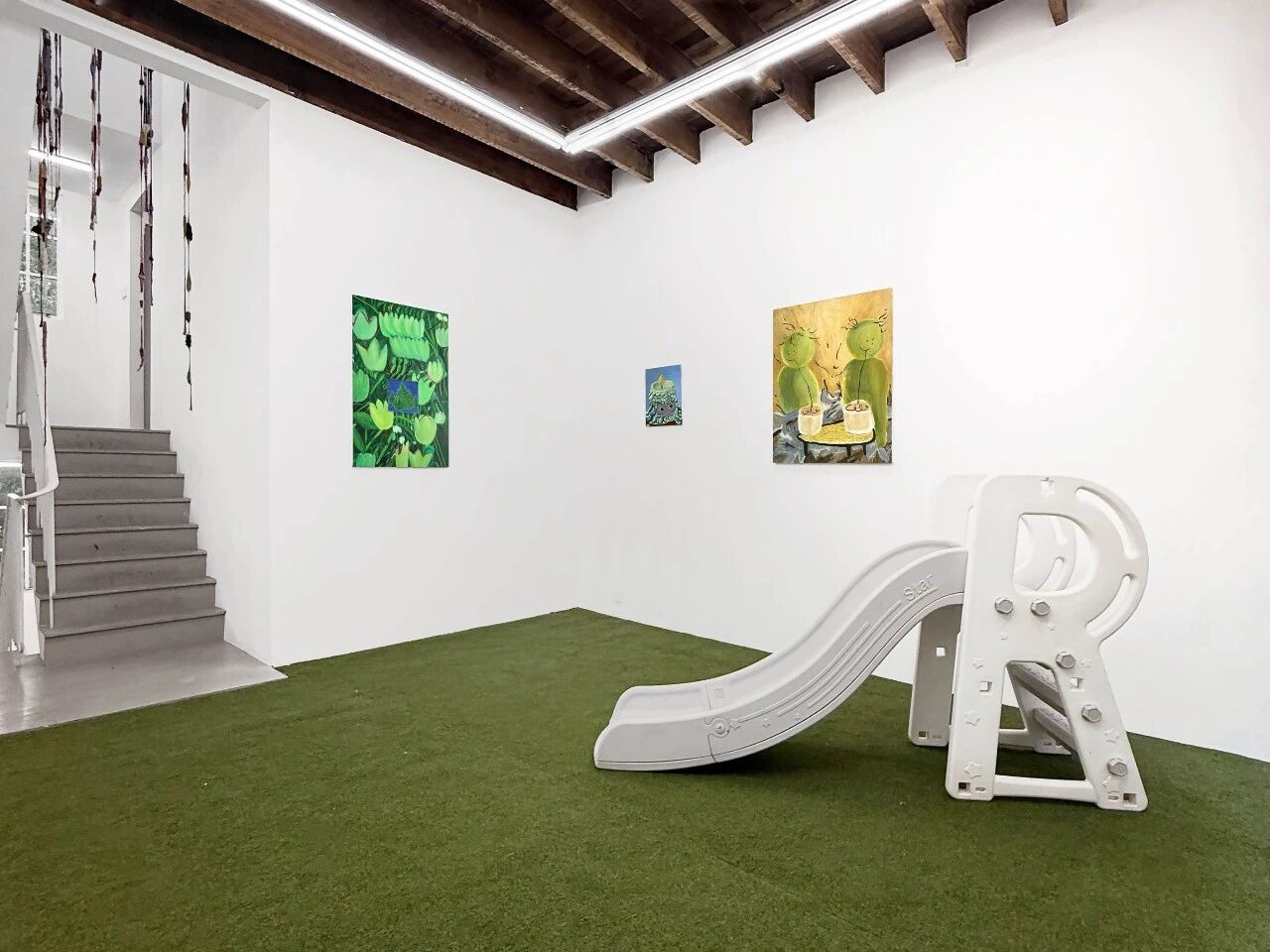
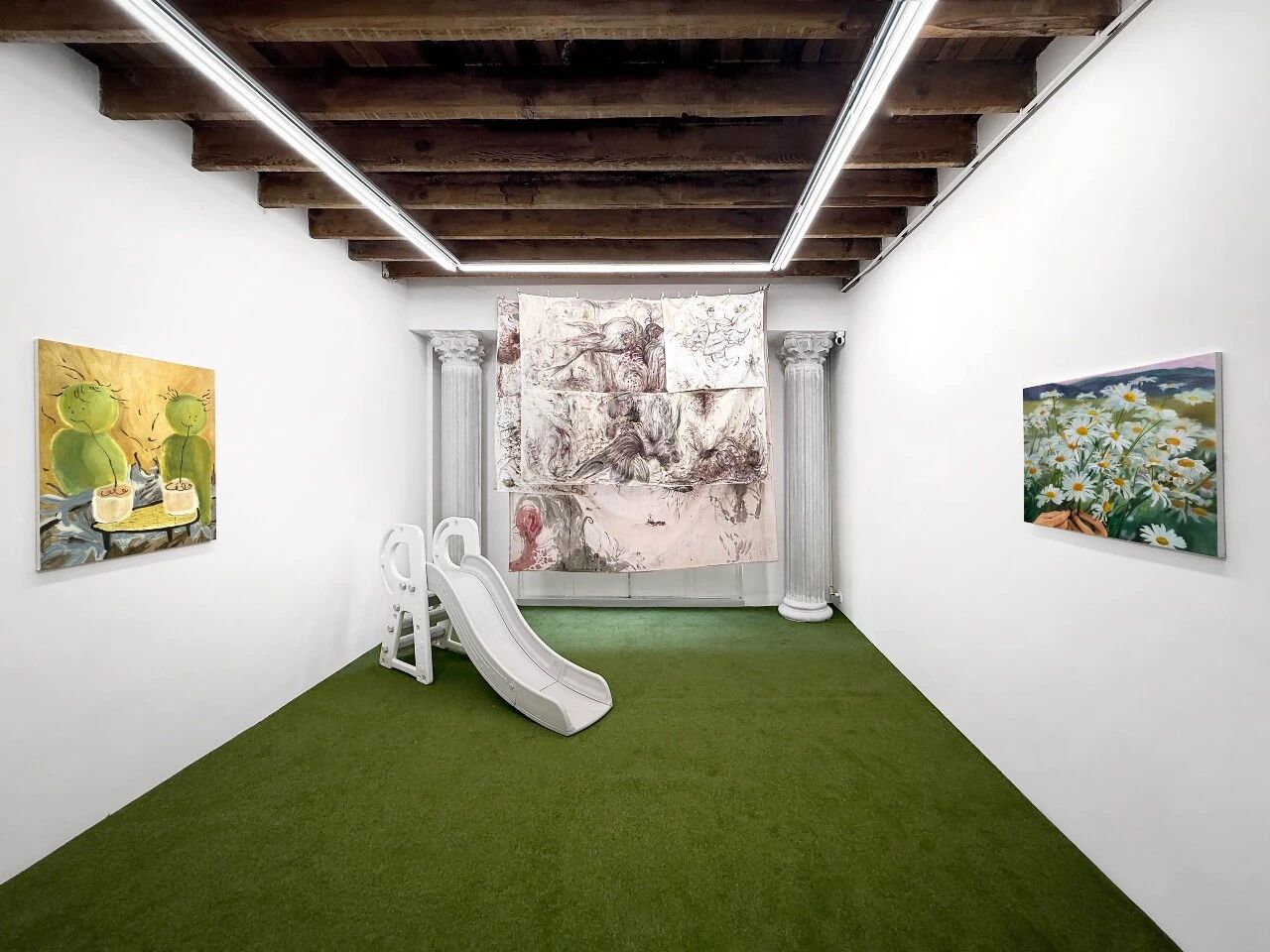
Installation view of the second floor of the exhibition, Of Woman Born, Nan Ke Gallery.
Tan Buru's works similarly revolve around the invisible labour embedded within domestic life. She paints on worn bed sheets, tablecloths, and other textiles that have long borne the traces of caregiving. The holes and tears left by time and repeated use become not only material records of the passage of time, but also quiet witnesses to the labour of motherhood woven into everyday life. Delicately repairing these fragile surfaces with silk thread, the artist restores new meaning to fabrics once marked by wear and vulnerability. At the same time, she approaches the paintbrush as though it were a blade, patiently "carving" graceful female figures with the precision of a monastic illuminator. Through this process, the gestures of everyday domestic labour are transformed into a slow and enduring form of spiritual practice.
Toba Yang's works turn instead to the everyday practices of motherhood. Acts of caregiving, emotional fluctuations, and fleeting moments of shared companionship together shape the rhythm of a mother's daily life. In Order/ désordre, she depicts the repetitive cycles of labor and exhaustion that accompany childcare. Yet what appears as disorder also marks the gradual emergence of a new order. Elsewhere, her paintings dwell on the quiet joys of everyday life and those brief moments in which energy is restored. For the artist, motherhood is not only a stable identity but also an experience that continually oscillates between chaos, repair, and becoming. Her works are concerned not with motherhood as a fixed state, but with the ongoing process of how, after becoming a mother, one continually reorganizes one's daily life, emotional world, and sense of self.
For Yuan Yuan, flowers gradually emerge as the central motif following motherhood. Long associated in the histories of art and literature with femininity and the female body, the flower becomes in her work more than a symbol of fertility. It also embodies intimacy, vulnerability, desire, and the enduring vitality of women's lived experience. Through this familiar iconography, she reclaims the female body not as an object of representation, but as a site of memory, subjectivity, and creation.
The Third Awakening (1965–1970)
Beginning in 1963, Adrienne Rich became actively involved in the feminist, anti-war, and civil rights movements in the United States. It was during this period that she began to formulate what would become one of the central tenets of her political thought: the personal is political. More than any other intellectual turning point, this realisation fundamentally transformed the way she understood both herself and the condition of women.
For years, Rich had asked herself a deeply personal question: Why am I suffering—as a woman, as a mother? Is it simply because I am not capable enough? After moving to New York in 1966 and beginning her teaching career, she found herself immersed in communities of women whose lives echoed her own. Through conversations, activism, and shared experience, what had once appeared to be an individual struggle gradually revealed itself as a collective condition.
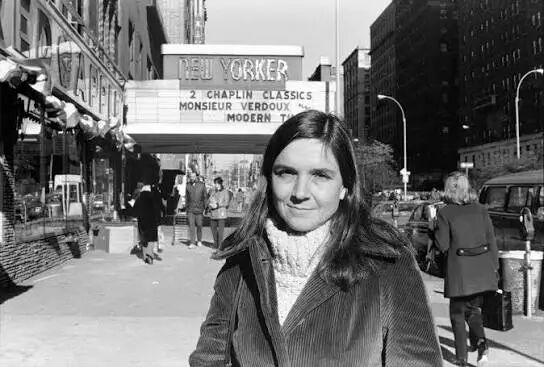
Adrienne Rich, in New York City, the1960s.
Looking to the women around her as both companions and witnesses, Rich encountered an ever-expanding range of female experience. As these personal narratives accumulated, she arrived at a decisive realisation: “No. Millions of women are living through the same contradictions.” It was this shift—from private anguish to structural analysis—that became the intellectual foundation of Of Woman Born. Drawing upon history, law, medicine, religion, psychoanalysis, and feminist theory, Rich sought to demonstrate that women are not born destined for motherhood; rather, motherhood is continually produced and regulated by social institutions.

Photo of Adrienne Rich in New York City at her studio, the1960s. Page from The New Yorker Magazine issued November 30, 2020.
The exhibition's third chapter presents two distinct imaginaries of female subjectivity.
In Cao Yu's work, the artist portrays herself dressed in a black suit—a garment long associated with authority and masculine power—seated atop a faucet with a posture of deliberate composure, her gaze directed downward toward the viewer. Through bodily gesture, sartorial symbolism, and the dynamics of looking, the work performs a subtle reversal of gendered power. When poses, behaviours, and visual codes historically assumed to belong to men are inhabited by a female body, viewers often experience an almost imperceptible sense of unease. Yet it is precisely this unease that reveals how deeply gendered norms have been internalised. Where does such discomfort originate? And once these invisible conventions are disrupted, what consequences must those who transgress them bear?
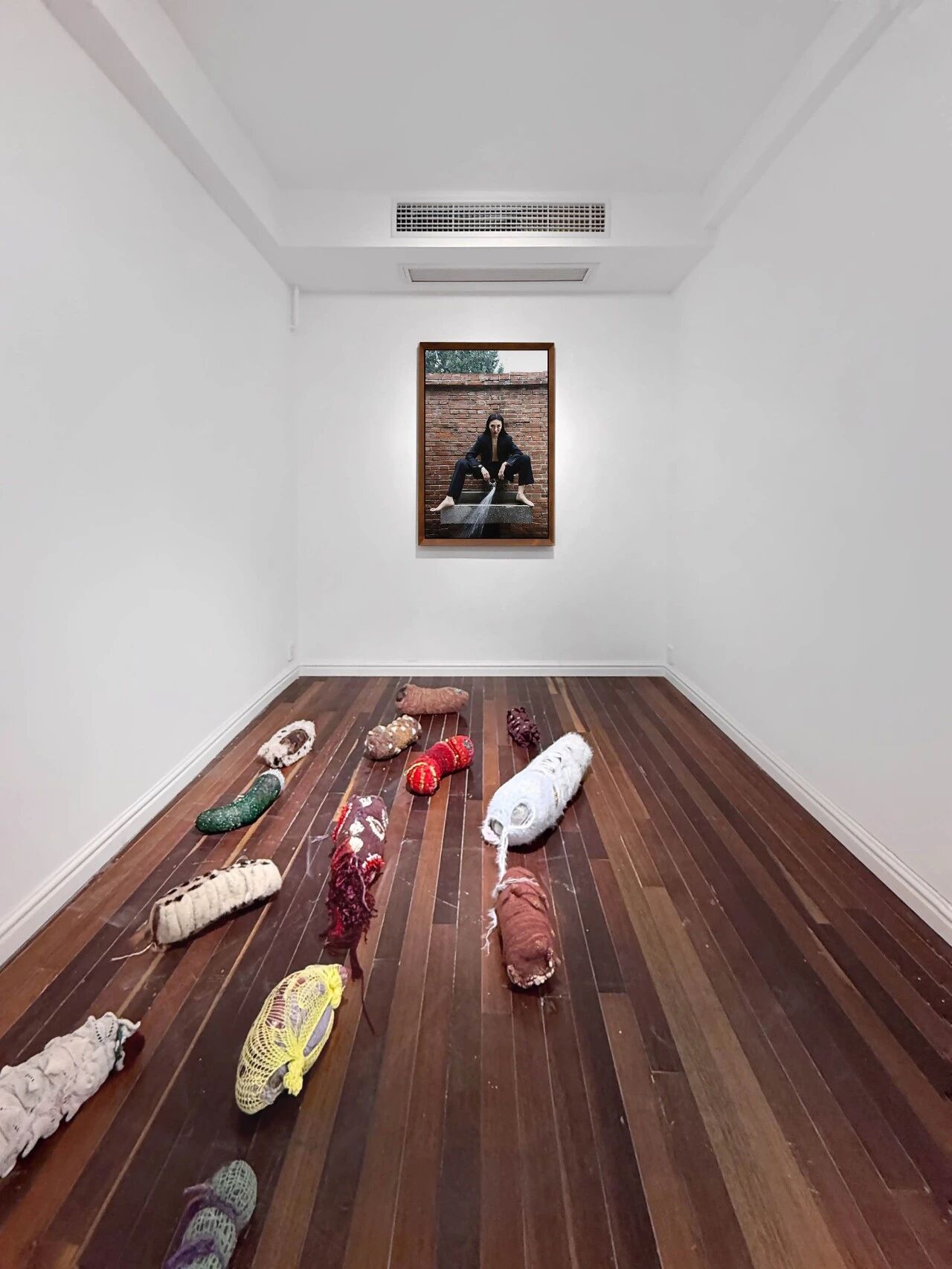
Installation view of the second and half floor of the exhibition, Of Woman Born, Nan Ke Gallery.
Tan Yao's knitted installation, Egg, returns another form of labour—one that has long remained invisible—to public consciousness. Through sewing, knitting, and textile practices, she responds to the repetitive, durational rhythms of maternal labour. Throughout history, men's participation in the public sphere has been recognised as productive labour, often accompanied by the social identities of provider, creator, or even hero. By contrast, the immense labour performed by women within the domestic sphere has largely been naturalised as obligation, its economic and emotional value rarely acknowledged. The cocoon that recurs throughout the work symbolises not only the patient weaving of family and life through countless stitches, but also the slow expenditure demanded by motherhood itself. What appears soft, intimate, and filled with love simultaneously bears the accumulated traces of time, bodily endurance, and emotional depletion.
Rich herself occupied a similarly liminal position during these years. She was at once a mother and a feminist thinker struggling to claim her own subjectivity. For her, the question was never whether motherhood should define a woman's existence. Rather, she came to understand that before one can become a mother, one must first become oneself.
The Fourth Awakening (1970–1976)
For Adrienne Rich, 1970 marked perhaps the most decisive turning point of her life. That year, she separated from her husband, Alfred Conrad, who took his own life shortly thereafter. The loss compelled Rich to reconsider the very foundations of marriage, family, and motherhood. Between 1971 and 1974, she devoted herself to feminist writing, publishing Diving into the Wreck while simultaneously undertaking the sustained research that would culminate in Of Woman Born. Drawing upon history, medicine, anthropology, psychoanalysis, and feminist scholarship, she began to formulate a comprehensive critique of motherhood as both lived experience and social institution.
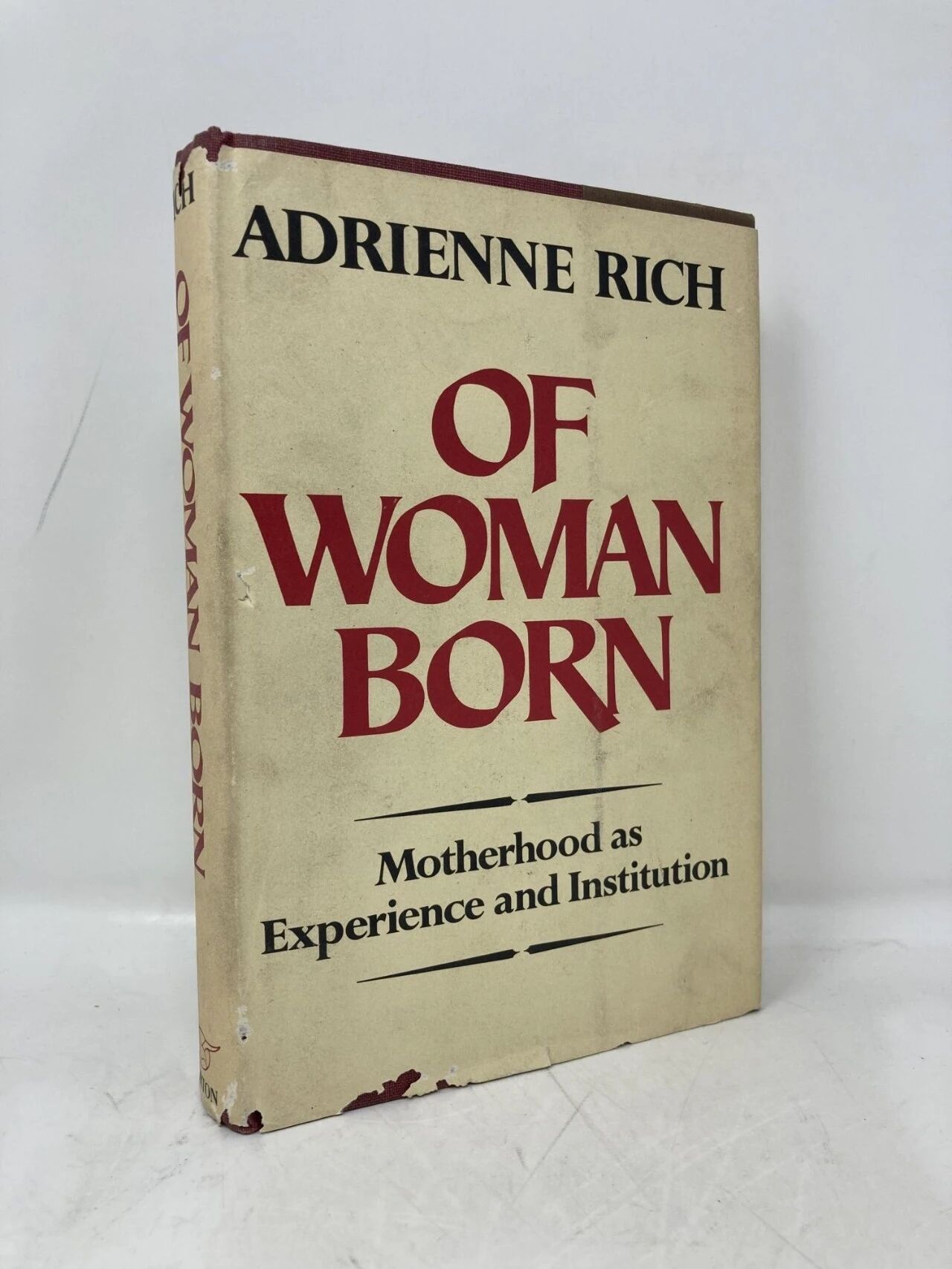
Adrienne Rich, Of Woman Born, first American edition published in 1976.
To redefine motherhood became the intellectual core of Of Woman Born. At the heart of the book lies one of the most influential conceptual distinctions in feminist thought: “Motherhood as an institution is not the same as mothering as lived experience.”
For Rich, Motherhood refers to a system collectively produced and maintained by the state, religion, marriage, the family, and the law. It demands that mothers be selfless, endlessly giving, sacrificial, and silent. Mothering, by contrast, names the intimate experience of nurturing a child: the creation of emotional bonds, the possibility of mutual growth, and the profound relationship between bodily experience and love. Rich regarded these as among the most creative and life-affirming capacities available to women. What oppresses women, she argued, is not motherhood itself, but the institution that governs it. This remains the central proposition of Of Woman Born.

Adrienne Rich and Michelle Cliff, in the 1970s.
After more than a decade of reflection, research, and writing, Of Woman Born was finally published in 1976. By then, Rich inhabited multiple identities at once: an acclaimed poet, the mother of three sons, a widow, and the life partner of the writer Michelle Cliff. Rather than resolving these identities into a single role, she embraced the tensions between them, allowing them to coexist within both her life and her writing. The exhibition's concluding chapter is enveloped in a quiet field of blue, where every work shares an atmosphere of stillness and introspection.
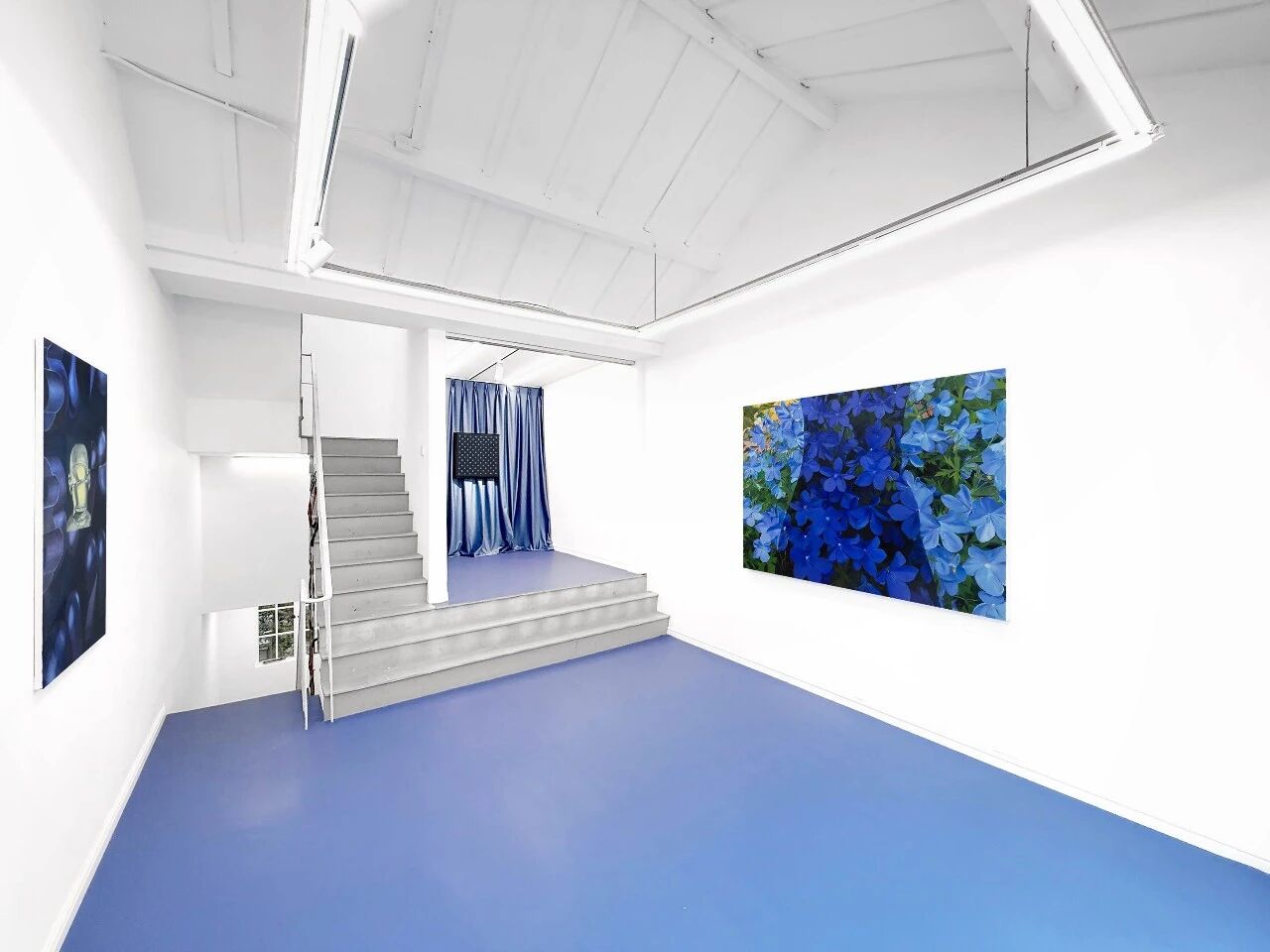
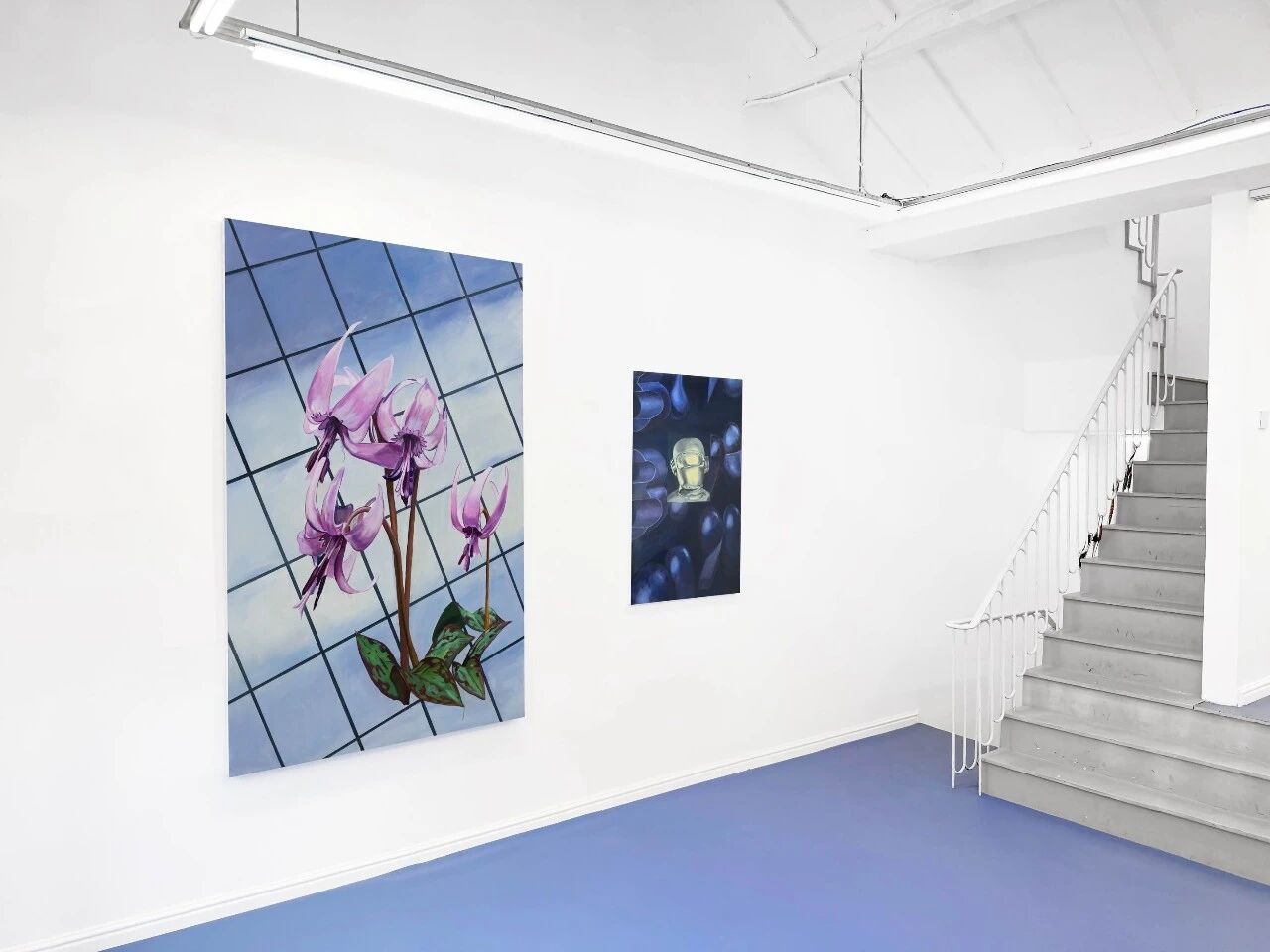
Installation view of the third floor of the exhibition, Of Woman Born, Nan Ke Gallery.
In Cai Yaling's work, strands of her mother's white hair become the primary material of the piece. Delicately embroidered into the polka-dot pattern of a dress her mother once wore in her youth, the individual hairs register subtle variations in tone, warmth, and texture, rendering the passage of time almost tangible. Here, a mother's vanished youth, together with the quiet erosions and enduring beauty of maternal life, becomes visible before us.
In Toba Yang's work, a figure wearing a metal helmet stands quietly before the viewer, its identity remaining deliberately indeterminate. The metal helmet concealing the face functions less as an act of self-erasure than as a protective gesture turned inward. It shields the wearer from the persistent gaze of the outside world while preserving a necessary interval of silence in which a renewed sense of self may gradually emerge. Motherhood does not entail the disappearance of subjectivity; rather, the profound transformations it brings to the body, the experience of time, and one's emotional landscape usher the individual into a transitional period of self-reorientation, during which subjectivity is reconfigured and renegotiated.
At the centre of Yuan Yuan's expansive blue field of flowers, the shadow of a female torso quietly emerges. The image echoes Rich's enduring inquiry into the female body: To whom does the body ultimately belong—to the woman herself, to the family, or, on a broader level, to society? Beneath the radiant halo so often projected onto motherhood, the individual shadow cast by the woman herself frequently escapes notice.
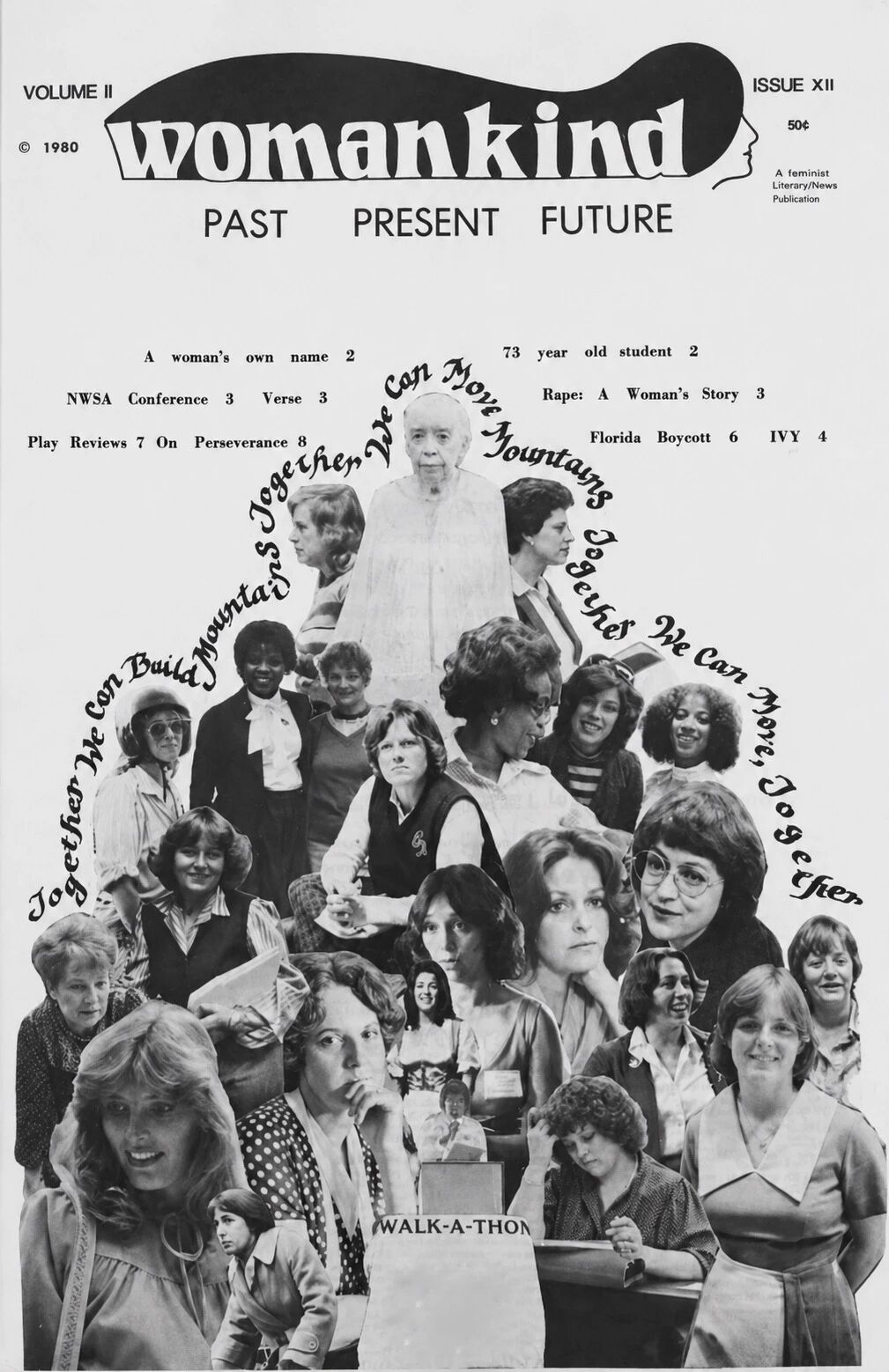
Cover of Womankind, Vol. 02, No. 12, 1980 Credit: Indiana University Indianapolis.
The significance of Of Woman Born ultimately extends far beyond motherhood alone. From a meditation on maternal experience, it evolves into a far-reaching theoretical framework through which to reconsider the body, language, identity, and structures of power. Since its publication, the book has become one of the foundational texts of feminist thought. The questions it poses are not whether women should become mothers, but whether women can truly possess their own bodies, claim their creative capacities, and, before loving others, first inhabit themselves as autonomous subjects.
Across more than six decades of writing and continual self-interrogation, Adrienne Rich chronicled not only her own life, but also the shared conditions of an entire generation of women. The questions raised by Of Woman Born remain strikingly unresolved. Every generation enters the world through women, and the labour of motherhood bears a weight no less immense than that of Atlas carrying the heavens upon his shoulders. Until that weight is fully recognised by society, we will inevitably return to the questions Rich first asked—and continue searching for the answers that our own time has yet to offer.
