

“You can return there, but no one is there anymore.”
In recent years, an internet-based visual phenomenon known as “Dreamcore” has gained widespread attention. Often employing low-resolution imagery, familiar yet deserted spaces, oversaturated colors, and scenes that evoke a vague sense of déjà vu, Dreamcore creates an atmosphere suspended between dreams and memories. It evokes a peculiar temporal dislocation: a certain place appears to still exist, and you vaguely remember what once happened there; yet when you truly return, what awaits you is merely an empty shell left behind by time.
This subtle sense of loss has accompanied a renewed fascination with the visual culture of the period around the millennium. From the late 1990s to the early 2000s, people imagined a future filled with brightness and possibility. The futurism of that era was characterized by vivid colors and optimistic fantasies: transparent plastics, metallic surfaces, streamlined forms, blue waves, dolphins, stars, digital interfaces, the iconic Windows desktop landscape of blue skies and green fields, and the flickering glow of electronic devices together formed a visual language of future life. Technology seemed destined to bring a freer, more open, and happier world; the future appeared within reach. Yet when these images return to our contemporary gaze, they carry a subtle sense of nostalgia—the visions that once belonged to the future have themselves become memories of the past.
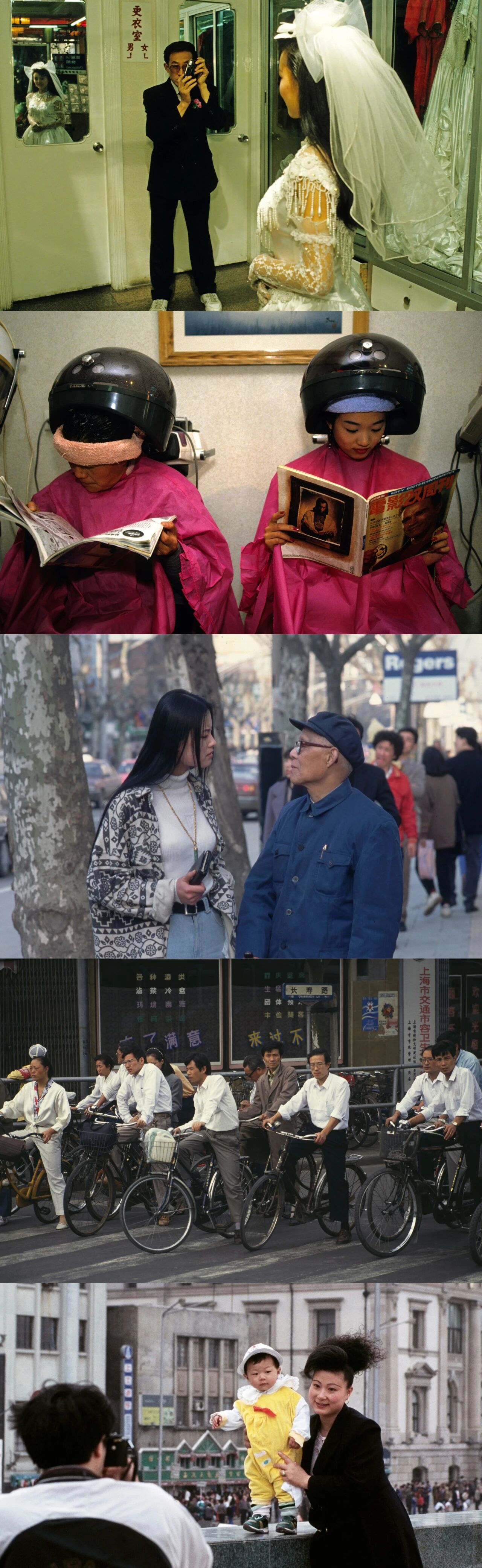
Photographs by Frances M. Ginter, Peter Charlesworth, Peter Turnley, and Andrew Holbrooke, taken in Shanghai during the 1990s. All images © their respective photographers.
For many people born in the 1990s, childhood unfolded within this particular temporal gap. Childhood often seems to exist under a light that is difficult to define. It resides in the photographs left behind by parents in their youth: a slightly faded family portrait, a cultural performance organized by a workplace, a festive occasion when a child stood before the camera wearing new clothes. It also exists in animated programs broadcast on old television sets, doodles in the margins of textbooks, and the voices of children playing downstairs after school. These images gradually lose their sharp contours, yet they preserve traces of a particular way of life, the distance between people, and a form of everyday existence that is slowly disappearing.
The generation born in the 1990s occupies a unique historical threshold. They were the last generation to experience a certain form of “pre-digital childhood,” while also becoming the first generation to fully enter the age of the internet. Their childhood contained two simultaneous temporalities: traditional neighborhood life, television animation, printed comics, collective games, and school activities, alongside the rapid arrival of computers, the internet, mobile phones, and consumer culture. This experience of living through a transformation of media environments became a distinctive form of collective memory for the post-90s generation, and also provides the temporal context for Tong Mo’s artistic practice.
Tong Mo
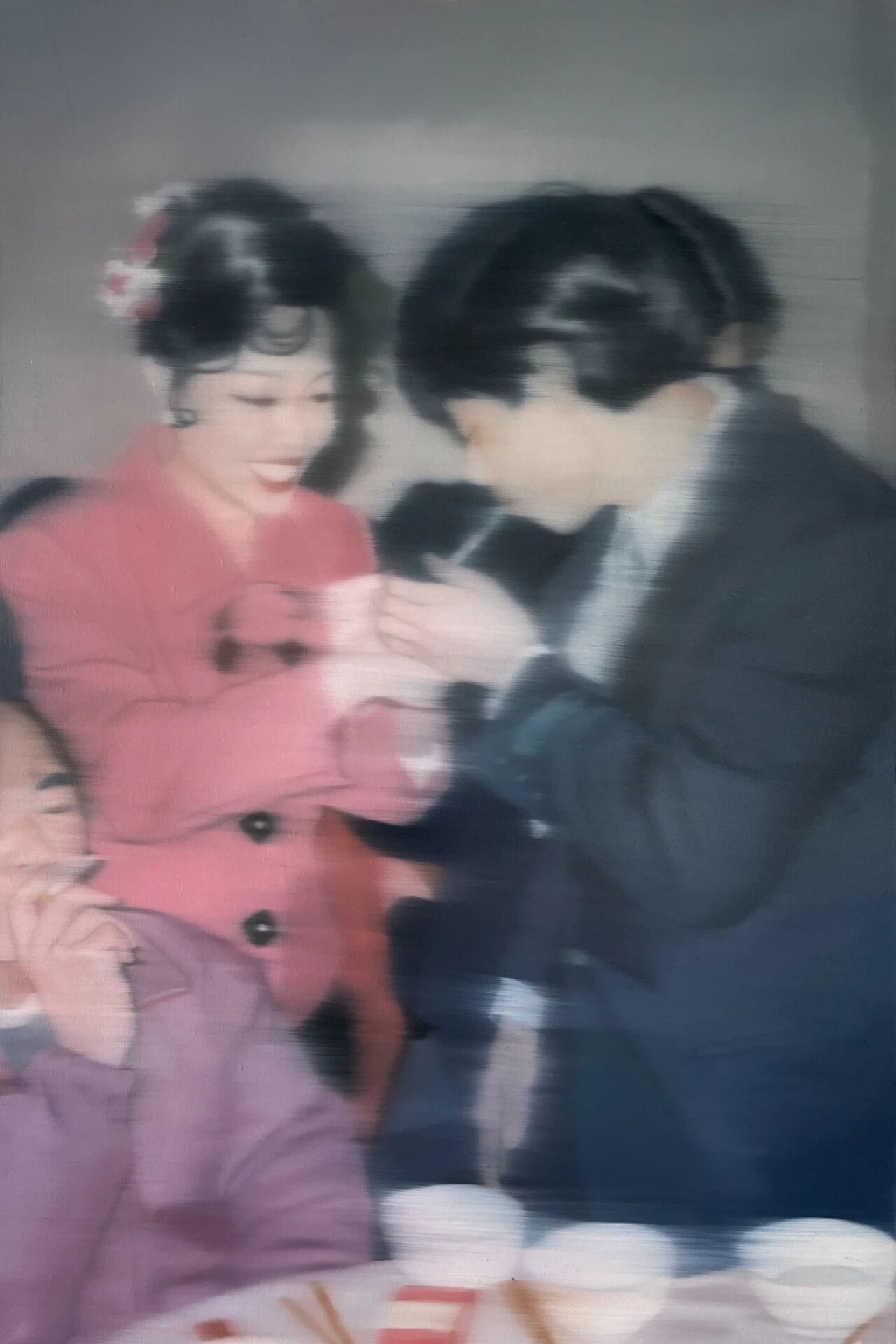
1997.12.28 No.1, 2023
Oil on canvas
120h x 80w cm
© Courtesy of the artist and the collector Shem Jacobs
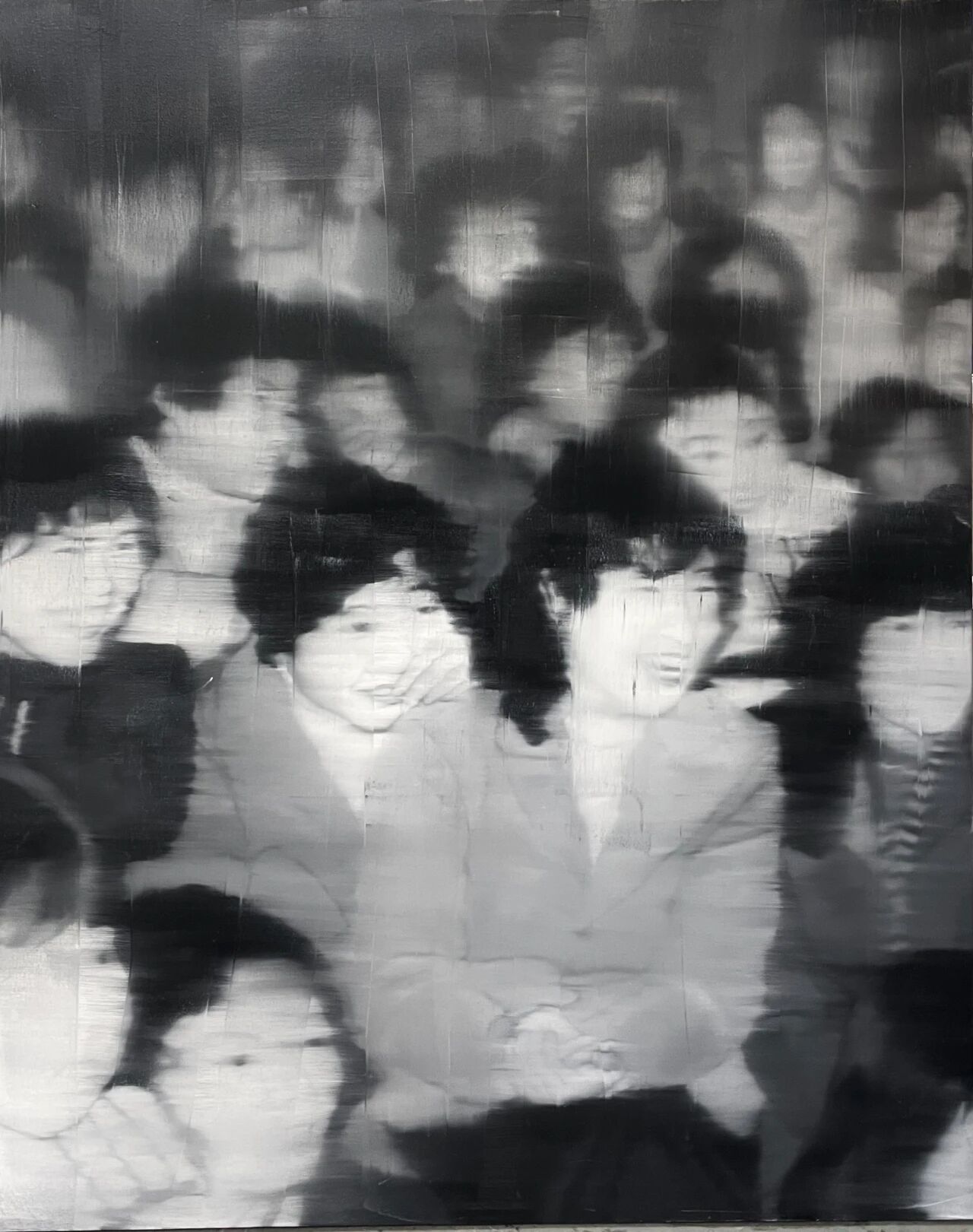
Tong Mo’s Collective Memory series focuses on historical experiences preserved through images. From fragments of history such as 1942, to cultural performances of the 1980s, family life in the 1990s, and scenes of growing up around the millennium, the artist brings visual fragments from different periods back into contemporary viewing. The figures, gestures, and environments within these paintings carry a sense of familiarity: performers on stage, family members gathered for photographs, and the slightly restrained postures of people facing the camera seem to emerge from everyone’s memories. Yet these images always maintain a subtle distance. Faces become blurred, bodies leave traces of movement through the brushwork, and photographic images originally intended as records are transformed into visual states suspended between reality and recollection. Tong Mo’s paintings linger on the moment when images begin to recede into the past, allowing scenes once covered by time to reappear.
The French sociologist Maurice Halbwachs introduced the concept of “collective memory” in the early twentieth century. He argued that memory exists within social relationships and is continually reorganized through collective experiences. A group’s understanding of the past is often sustained through shared languages, images, rituals, and cultural symbols. While history preserves the trajectory of events, collective memory preserves a community’s emotional relationship with the past. It exists in repeatedly narrated stories, preserved images, and certain moments that can evoke recognition without explanation. What Tong Mo explores is precisely these fragments located between individual experience and social memory.
Tong Mo
Workers of a MSG Factory Watching a Cultural Performance, 2024
Oil on canvas
150h x 120w cm
© Courtesy of the artist and the collector DTR
For the post-90s generation, many of the scenes depicted in Tong Mo’s paintings do not entirely belong to their own direct experiences. Instead, they enter their lives through family photographs, parental narratives, and social imagery. Jan Assmann’s theory of cultural memory suggests that societies preserve their identities through images, symbols, and rituals, allowing the past to continue participating in the present. Tong Mo’s works reveal this process of transmission: how the experiences of one generation are passed through images and reinterpreted by another. The youth, lifestyles, and social experiences of the previous generation acquire new emotional significance through this act of viewing.

Tong Mo
Offering Cigarettes No.1, 2024
Oil on canvas
180h x 135w cm
© Courtesy of the artist
This exploration of the relationship between images and memory also resonates with a long-standing concern in Chinese contemporary art: the relationship between private experience and historical consciousness. Since the 1990s, many Chinese artists have turned toward family, portraiture, and personal experience as ways of examining how individuals are connected to broader social histories. Among them, Zhang Xiaogang’s Bloodline: The Big Family series represents a significant example within this trajectory. Drawing from the visual language of Chinese family portraits, Zhang transformed individual faces into symbols of collective identity. The similar expressions, formal postures, and frozen gazes in his paintings point simultaneously toward familial relationships and the complex relationship between individuals and collective history during specific historical periods.
If Zhang Xiaogang’s paintings examine how an era shapes the appearance of individuals, Tong Mo turns his attention toward how later generations view and inherit the images left behind by that era. Both artists begin with the family image as a point of departure, exploring the relationship between private life and social experience. Zhang reveals the psychological structures left by historical experience, while Tong focuses on how images that have already entered the past regain emotional resonance in the minds of new generations of viewers. For Tong Mo, the past enters the present through photographs, personal stories, and family narratives, becoming a visual heritage that continues to exist.
Tong Mo
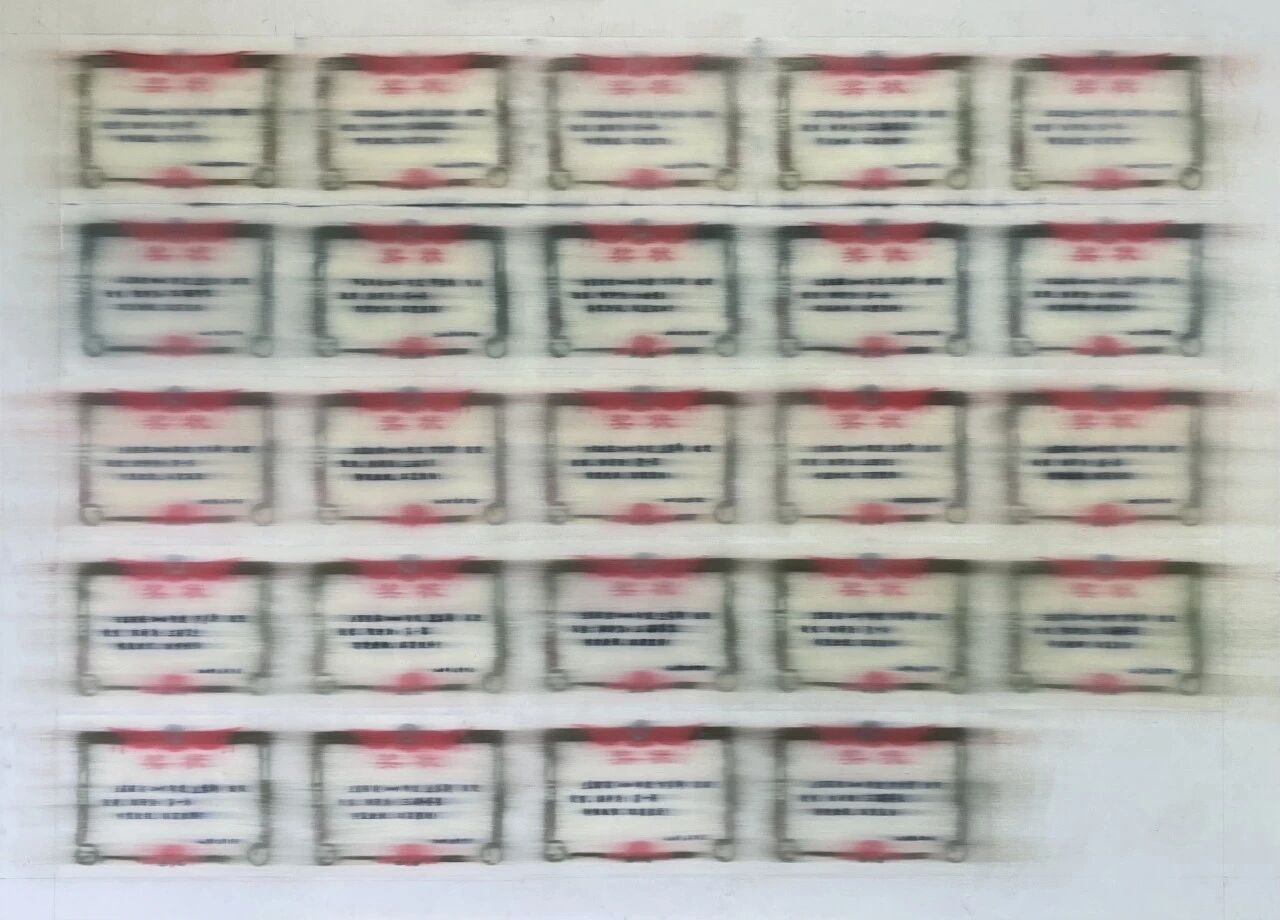
My Fantasy Certificate of Merit, 2023
Oil on canvas
120h x 160w cm
© Courtesy of the artist and the Collector
In terms of painting language, Tong Mo continues the twentieth-century artistic exploration of the relationship between photography and painting. Gerhard Richter’s early paintings, based on newspaper images and family photographs, transformed photographic imagery through blurring, layering, and dragging gestures, allowing images to enter a realm of memory, perception, and uncertainty. Tong Mo similarly begins with photographic sources, transforming the atmosphere of an era, emotional experiences, and personal impressions into painterly language. His use of blurring becomes a way of approaching the very nature of memory itself.
In works such as My Beauty, Ballerina, and Black Vest, Tong captures fleeting moments within individual lives, extracting gestures and emotions from their specific contexts and transforming them into more universal psychological experiences. Works such as My Childhood · Certificate of Merit and 1998/12.28 NO.4, meanwhile, further point toward the shared background of a generation’s growth. Certificates, school environments, and family photographs—these fragments of everyday life gradually become visual symbols capable of evoking collective recognition after being filtered through time. Memory preserves the light of a particular afternoon and the joy brought by a certain game, yet it often loses the precise details of time and place. We remember the people who grew up alongside us, only to discover that their faces have gradually faded within the passage of time. In this sense, blurring becomes a truthful representation of memory itself: it preserves not the image alone, but the emotional traces behind it.
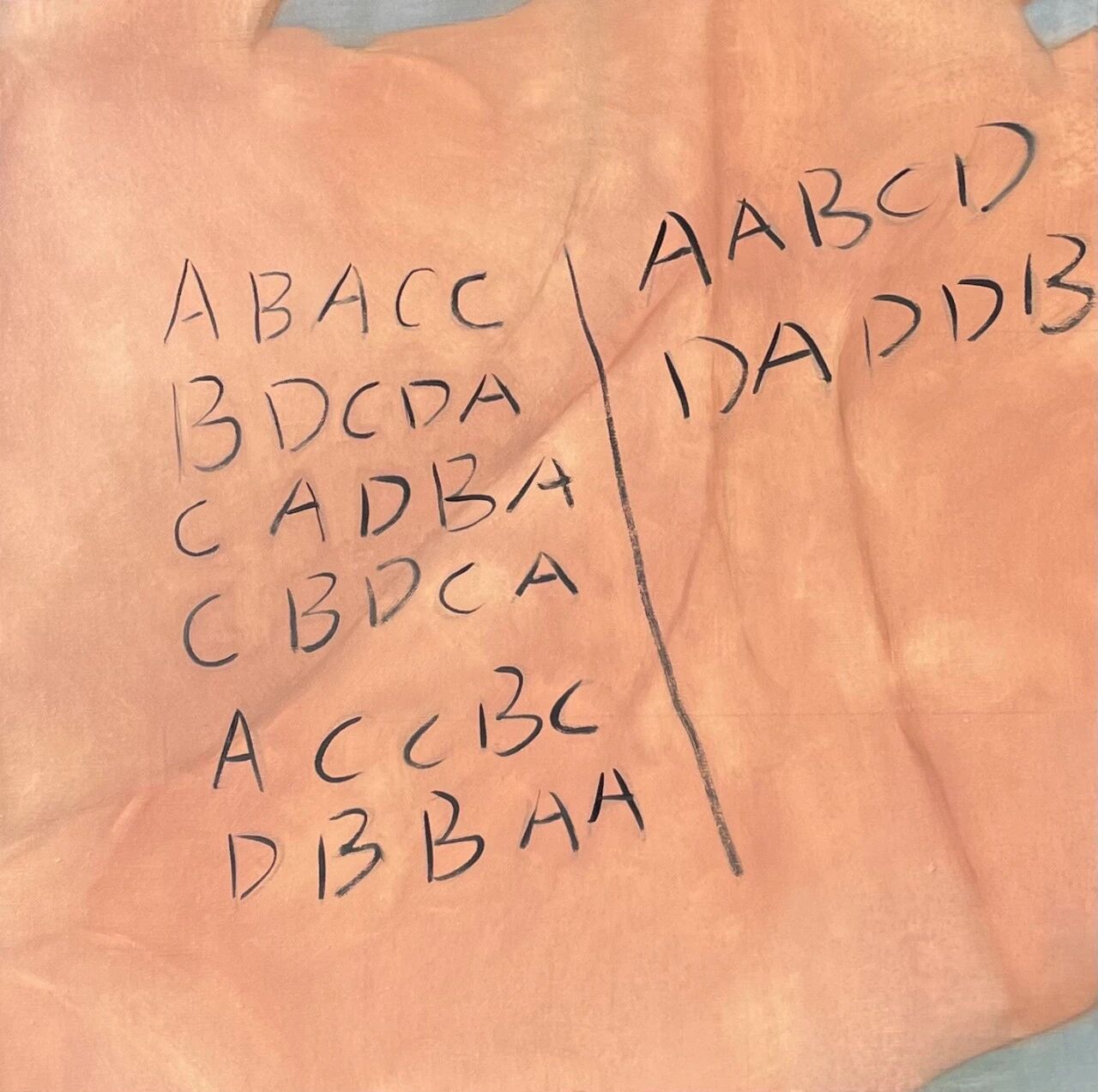
Tong Mo
Cheat Sheet, 2024
Oil on canvas
50h x 50w cm
© Courtesy of the artist and the X Museum Collection
If the earlier Collective Memory series was primarily concerned with a young artist’s contemplation of his parents’ generation, Tong Mo’s recent works gradually return to his own experiences, turning toward memories that truly belong to his own childhood. This shift represents a change in the position of viewing: the earlier works looked toward a past transmitted through family images and social photographs, while the recent works enter the artist’s own experience of growing up, searching for those childhood fragments that were once ordinary but are now disappearing.
For the post-90s generation, childhood preserves a deeply embodied experience: waiting downstairs for friends after school, spending endless afternoons on simple games, sharing conversations around television programs broadcast at fixed times, and forming one’s earliest imagination of the world through collective school activities. As the internet and smart devices entered everyday life, childhood gradually became more digitalized and individualized. What Tong Mo’s recent works touch upon are precisely those shared moments that continue to remain within bodily memory. Moving from images of the previous generation back toward his own experiences of growing up, the artist traces memories that were never fully documented yet continue to exist through sensation and emotion.
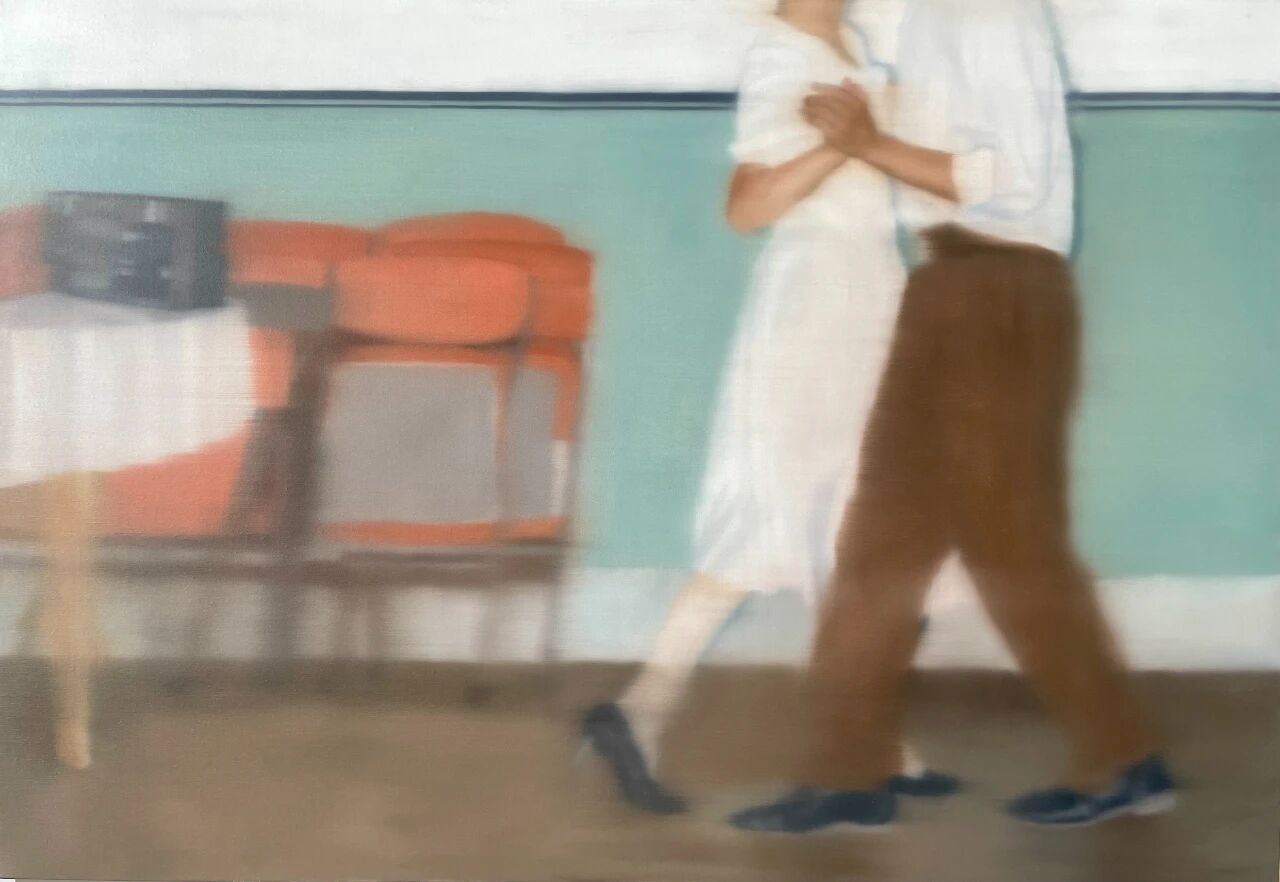
Tong Mo
Drunken Tango, 2024
Oil on canvas
103h x 150w cm
© Courtesy of the artist and the Collector Pandora Wang
In Drunken Tango (2024), the relationship between figures becomes the central focus of the composition. Two people move through space, their bodily boundaries gradually dissolving through the movement of the brush, approaching one another while maintaining a certain distance, like a dance that can never be fully recorded. Here, blurring continues Tong Mo’s exploration of time while also becoming a visual expression of the fragile states of human relationships. Playing Cat’s Cradle (2026) further responds to the shared childhood memories of the post-90s generation. As a game completed through the cooperation of two hands, cat’s cradle generates constantly changing forms through exchange, adjustment, and coordination. The red lines extending through the painting trace the pathways of childhood, while also symbolizing the process through which memories are created collectively between people.
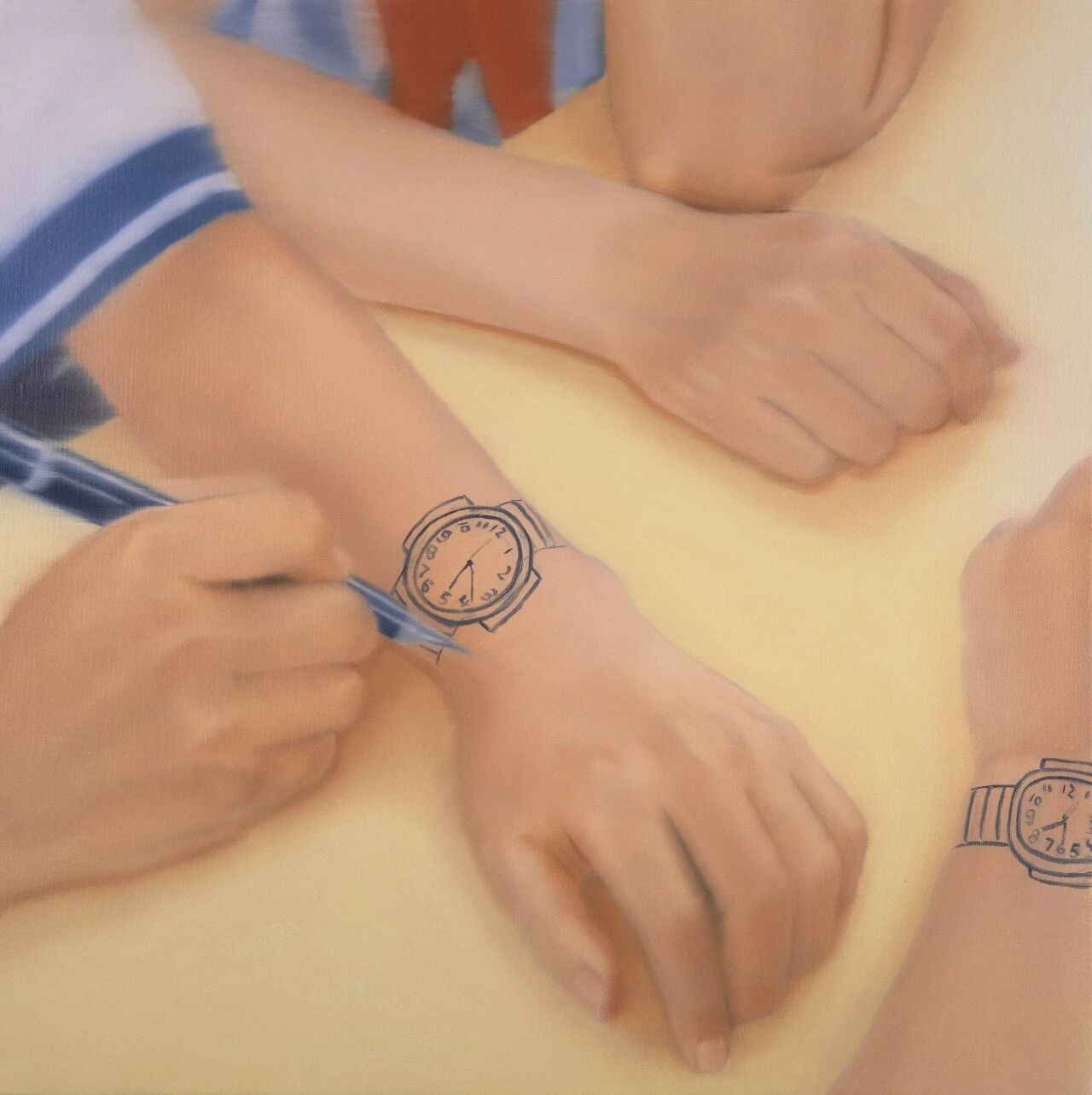
Tong Mo
Draw a Watch on the Wrist, 2026
Oil on canvas
60h x 60w cm
© Courtesy of the artist
Tong Mo’s engagement with memory carries a distinctly Chinese historical experience. The family photographs, collective activities, and childhood scenes preserved in his works do not belong solely to an individual or a single family; they also bear traces of a society undergoing rapid transformation. Unlike the relatively continuous experience of modernization in many Western societies, China’s development over the past several decades has been accompanied by profound changes in social structures: urban landscapes have been continuously rebuilt, lifestyles have shifted rapidly, traditional community relationships have gradually disappeared, and new digital media have reshaped the ways people connect with the world. Therefore, an old photograph within the Chinese context often possesses a significance beyond personal remembrance—it preserves not only an individual’s past, but also a world that has already vanished.
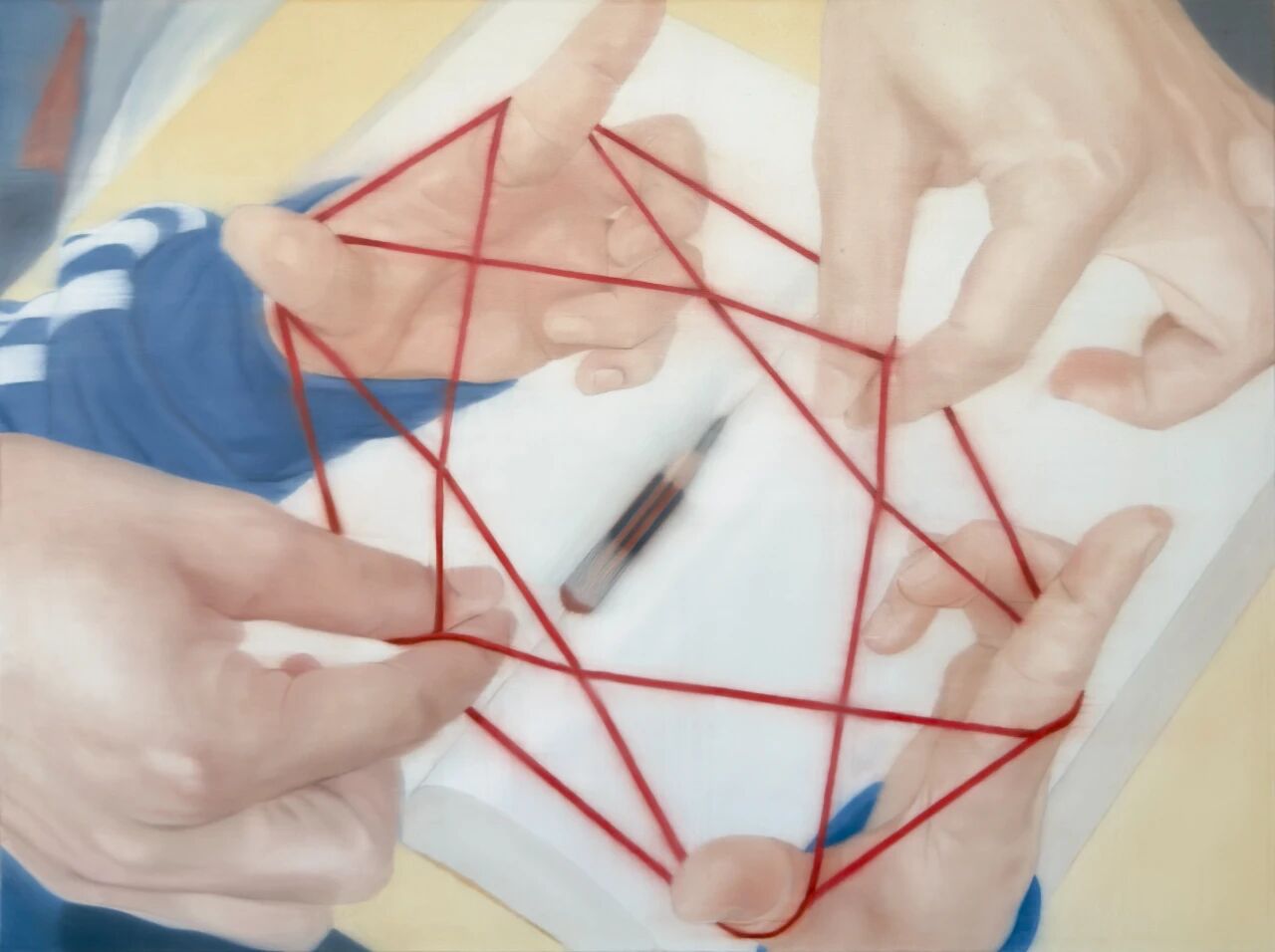 Tong Mo
Cat's Cradle, 2026
Oil on canvas
180h x 135w cm
© Courtesy of the artist
This historical experience gives Chinese collective memory a particular complexity. Many significant experiences of an era do not exist solely within grand historical narratives; instead, they remain preserved in family albums, everyday objects, and intergenerational storytelling. The figures in these photographs may simply be ordinary family members, and the scenes may depict nothing more than a gathering, a performance, or a moment of growing up. Yet it is precisely within these small personal images that the emotional structures of an era are preserved. Tong Mo’s reexamination of these images responds to the relationship between private memory and social history.
For the post-90s generation, this experience carries another layer of specificity. They grew up during a period of rapid transformation in Chinese society, becoming the last generation to share a relatively collective offline childhood and the first to enter a fully digital life. The neighborhood spaces where children played, the shared rhythms created by television programs, and collective memories formed through school activities now coexist with the increasingly individualized experiences shaped by the internet age. Tong Mo’s recent reflections on childhood touch upon a particular moment within China’s modernization process: a shared world of childhood is gradually disappearing, yet its traces continue to exist within the bodies and emotions of this generation.
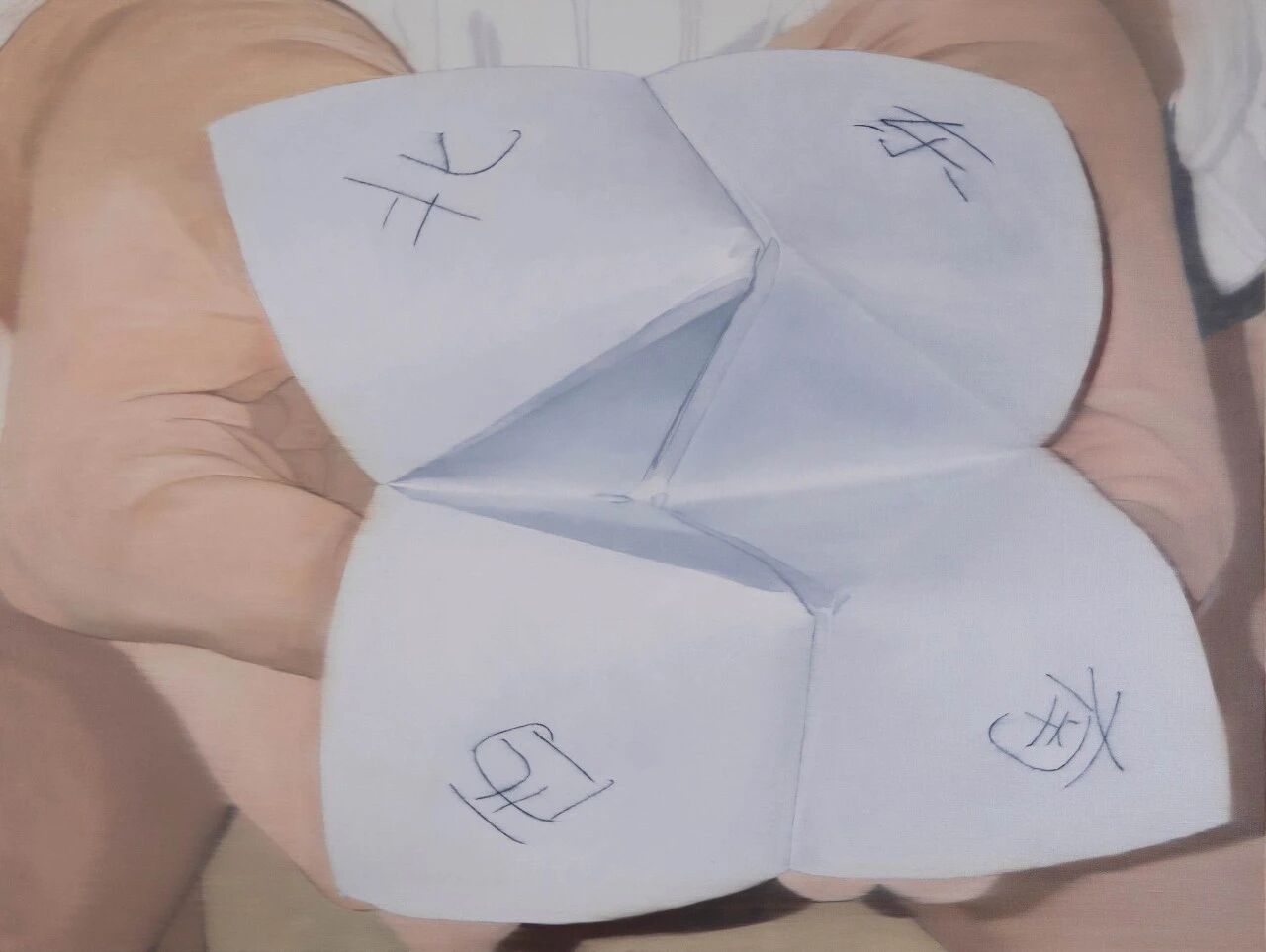 Tong Mo
Cootie Catcher, 2025
Oil on canvas
90h x 120w cm
© Courtesy of the artist
From images of their parents’ era to memories of his own childhood; from preserved historical fragments to sensations that remain within the body, Tong Mo’s artistic practice unfolds as a search for time and memory. His paintings resemble a gentle form of archaeology, allowing faded faces, blurred scenes, and emotions that resist precise naming to re-emerge on the canvas. These images originate from particular families and specific historical moments, yet gradually become a shared spiritual inheritance for a generation experiencing a profound transformation of time.
Through painting, Tong Mo traces the echoes left behind by the past. His work responds to a deeper question: after China’s modernization, how does a society preserve its private memories? How does a generation that has experienced immense transformation confirm that it once belonged to a shared world? Those moments carried away by time continue to exist through images, bodies, and acts of viewing.