

We tend to believe that a person begins with their own life. Memory accumulates, flesh grows, and gradually, like concrete and bricks, an individual is constructed. "Mother" is merely a member of the family, a marker within a web of relationships. In childhood, she is indispensable, the object of our deepest attachment; as time passes, she becomes the one we struggle against, and eventually, drift away from.
In Of Woman Born, Adrienne Rich writes, "I had to become a different kind of woman." Yet she—and perhaps all of us—inevitably arrives at the moment when the inheritance that transcends generations becomes impossible to deny. It follows us like a ghost: unsettling, yet strangely tender. Marianne Hirsch, whose theory of postmemory examines the second generation of Holocaust survivors, argues that our existence does not simply begin with our own lives, but emerges through the stories of those who came before us. The same may be said of mothers. What they leave behind extends beyond bodies, identities, or language. It also resides in gestures, habits, emotional patterns, and ways of seeing the world that reveal themselves only much later, like a drop of blood dissolving into the current of time, slowly spreading outward to connect two souls once believed to be separate.
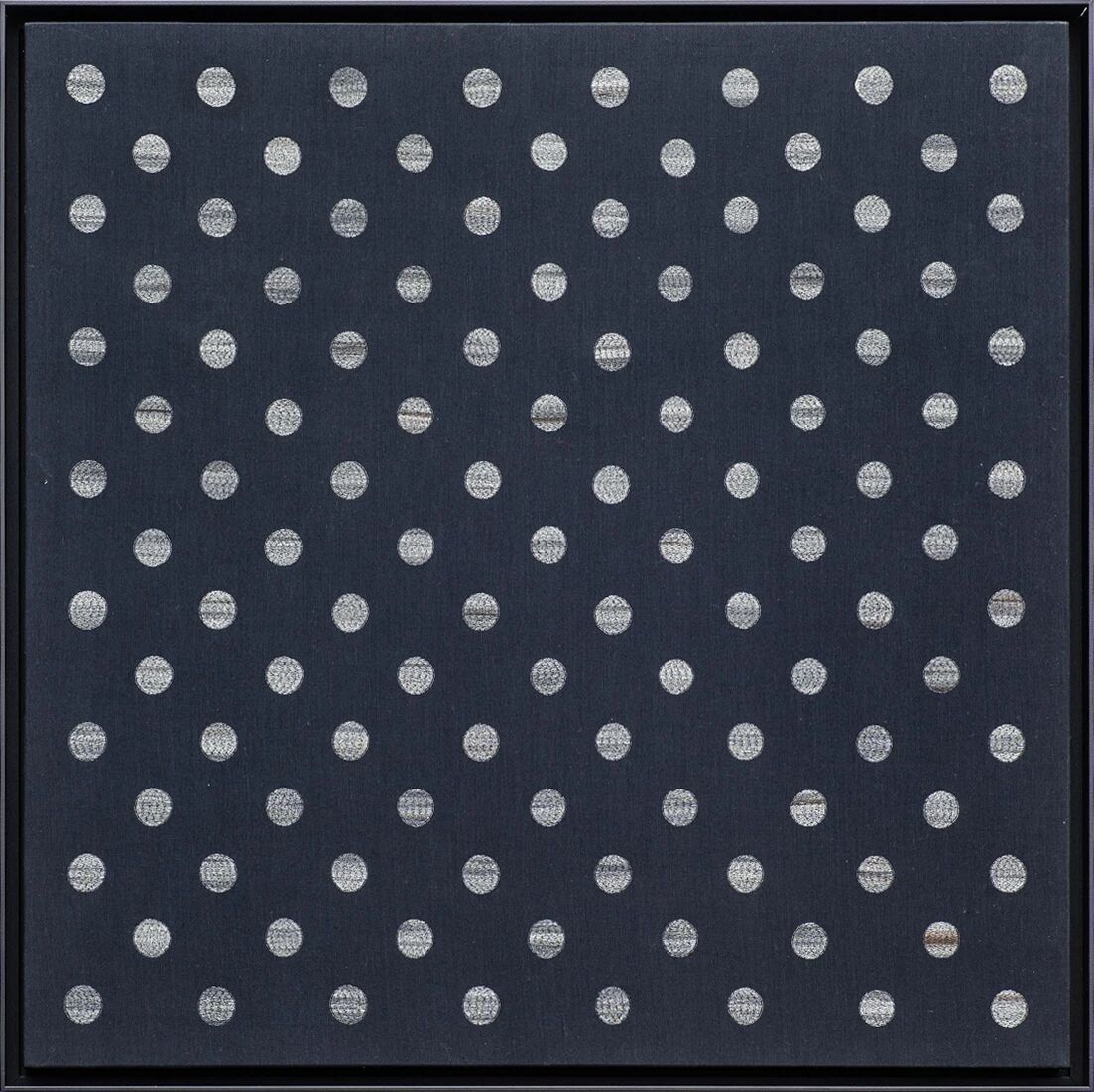
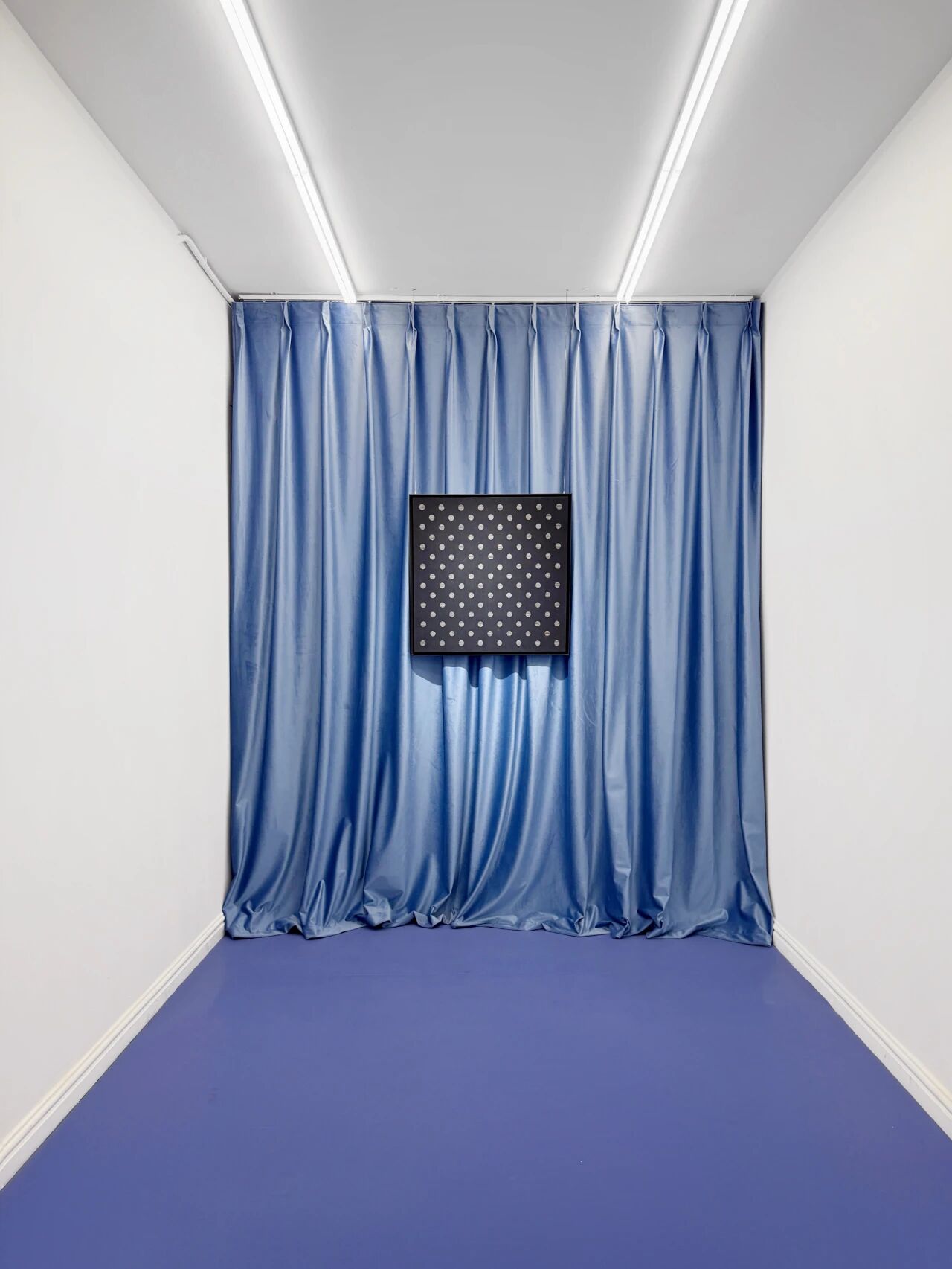
Cai Yaling
Polka dot-white ,2014
Mother's white hair, cloth
60hx60wx6d cm
© Courtesy of the artist
In the exhibition, Cai Yaling's Polka Dot - White is presented against a field of blue velvet, evoking the dreamlike texture of memory. Across a black textile, rows of white dots are meticulously embroidered using the artist's mother's grey hair, conjuring the youthful vitality of an earlier generation—a journey we never witnessed, even though we once inhabited that same stretch of time alongside our mothers. The care and nurture we received became the roots that anchored her within the home, while the polka-dotted dress preserved in memory reminds us that she also belonged elsewhere. She possessed an outside world, an upright body, and branches free to sway in the wind.
To a child, polka dots carry an imagination of adulthood, almost the reverse of Rich's declaration:I wish I could become this kind of woman. The strands of grey hair, stitched into the fabric, mark another fragment of time—one that follows rebellion, making space for conversation and reconciliation. Between these two moments lie the years that disappeared from view: years lived not only as "a mother," but as a person navigating uncertainty and conviction, sorrow and joy.
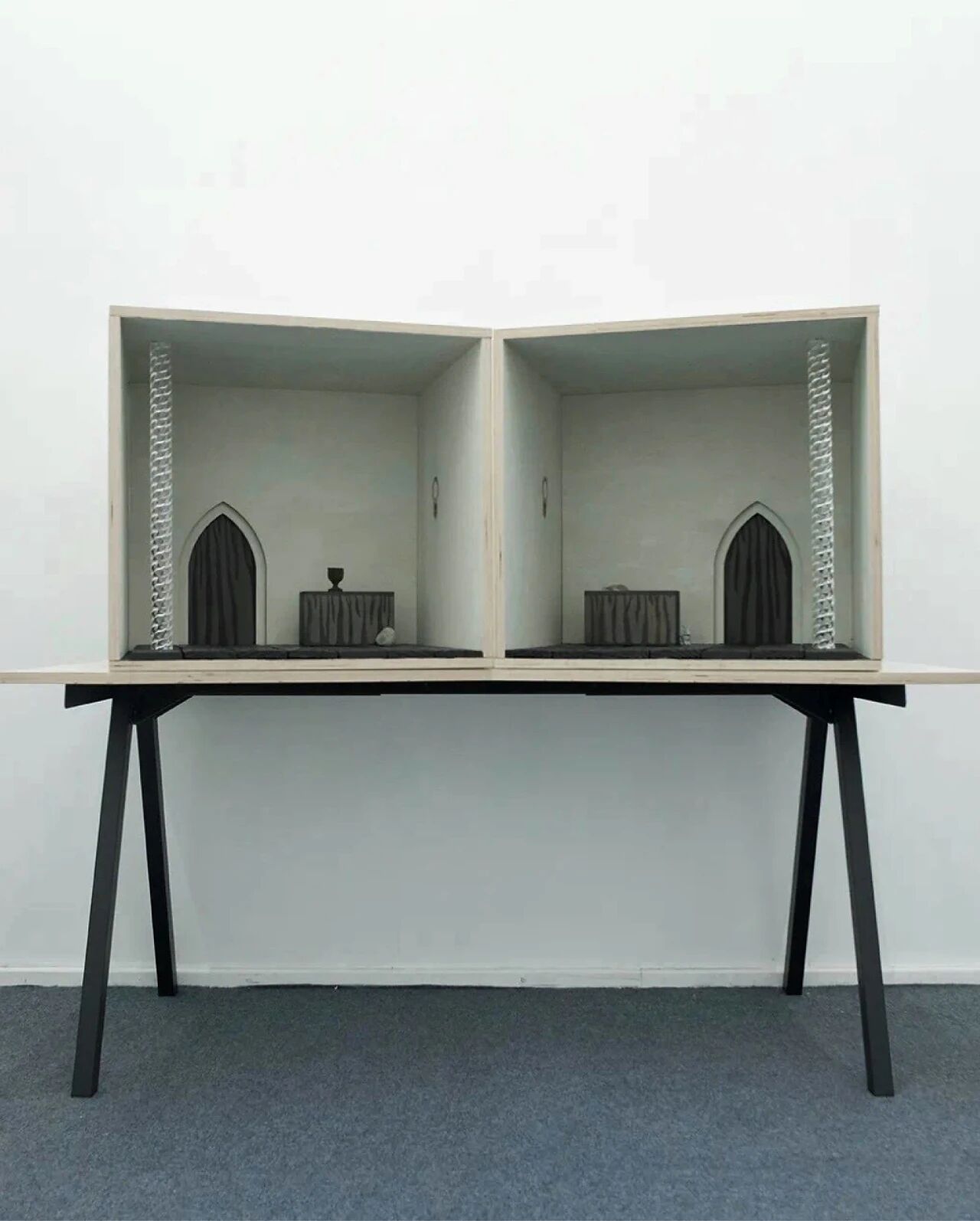
Amber Xiangning Lu
Unsolved ,2022
Oil on panel, wood, metal, resin, found objects
135h x155wx75d cm,
◎ Courtesy of the artist
Within the dynamics of family and the experience of growing up, it is difficult to imagine everything contained within this invisible middle passage of a mother's life—the years that, to a child, pass as imperceptibly as air. Lu Xiangning's Unsolved offers a rare opportunity to peer into her mother's desk, a space belonging entirely to her as an individual. Symmetrical boxes contain the freedom of her imagination. Gothic novels, mysteries, and other elements far removed from conventional ideas of motherhood appear one after another, provoking an unexpected response: lightness, immediacy, excitement. Nothing resembles what we conventionally recognise as "the maternal." Nothing resembles the traditional image of a mother.


Installation view of Of Woman Born, June 13, 2026 - July 26, 2026, Nan Ke Gallery, Shanghai © Courtesy of Nan Ke Gallery
More familiar are two opposing archetypes: the "ideal mother"—patient, understanding, gentle, effortlessly graceful—and the "oppressive mother"—demanding, emotionally inaccessible, conservative. This binary shares a striking structural resemblance to the widely criticised Madonna–Whore complex, in which women are imagined as either selfless and worthy of reverence or desiring and therefore diminished. Beneath both lies the same underlying logic: the woman being looked at is never regarded as an individual, but as a vessel onto which other people's needs are projected.
Mothers are trimmed like the string beans in their own hands, their beginnings and endings removed until only the sharpest fragments remain. Reduced to a binary, their contradictions disappear. Their personalities, their lived experiences, their existence as individuals are erased by the very categories meant to define them. Ultimately, the "ideal" and the "oppressive" mother are one and the same: edited, reconstructed according to demand, and made useful.
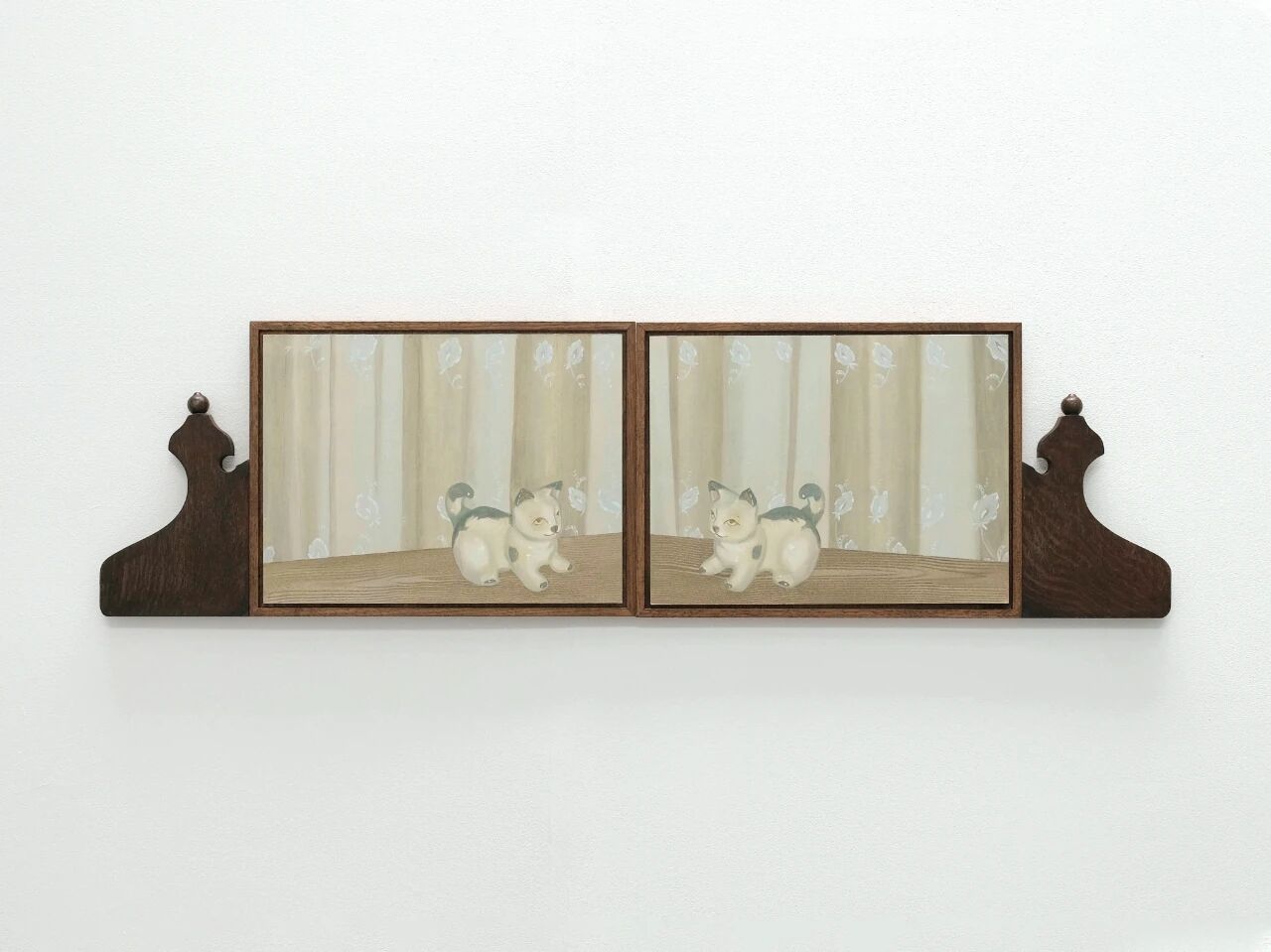
Amber Xiangning Lu
Pair, 2023
Reclaimed oak, wood, oil on panel
33h x123w x2d cm
◎ Courtesy of the artist
In Lu Xiangning'sPair, mirroring and separation coexist. Objects from the previous century evoke a sense of continuity across time, yet remain enclosed within distinct frames, each clearly separated from the other. Such separateness is difficult to achieve within the parent-child relationship. Once, the child was not yet a person, but soft flesh in need of food, of watchful eyes, of hands stroking a tiny back. Once, the mother was not yet a person either, but warmth, nourishment, and the measure by which the world itself was understood.
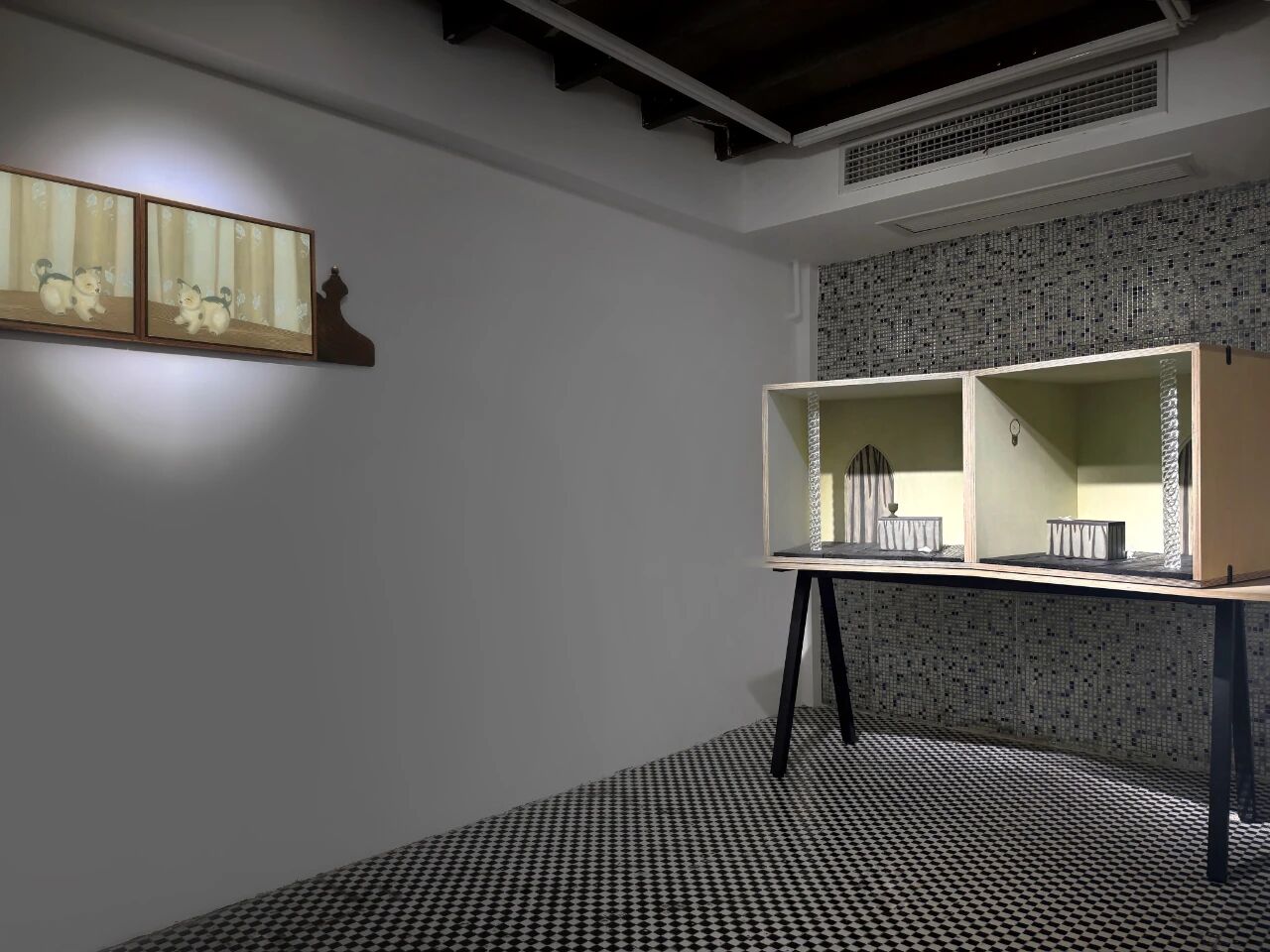
Installation view of Of Woman Born, June 13, 2026 - July 26, 2026, Nan Ke Gallery, Shanghai © Courtesy of Nan Ke Gallery
How do we truly see one another after profound hurt? How do we continue walking together once our paths have diverged beyond recognition? Narratives of unconditional forgiveness or tidy reconciliation no longer persuade us, because the complexity of the mother-child relationship arises from the institution of motherhood itself rather than from the individual who inhabits it. The person called "mother" cannot—and should not—bear the full burden of reconciliation. It is here that Axel Honneth's concept ofrecognition becomes meaningful. Recognition is neither affection nor agreement. It is the acknowledgement that another person possesses experiences, desires, histories, and a subjectivity that are irreducibly their own.
When it comes to mothers, perhaps transformation, embraces, and belated apologies were never the point. The identity of "mother" lingers like a ghost, quietly haunting both the child and the woman herself. It neither disappears nor asks to be exorcised. Recognition allows this haunting to remain gentle: to acknowledge the ties that cannot—and need not—be erased, without requiring one life to consume another; to recognise that one person's life will continue to echo through another's, while never dissolving either into the other. Perhaps this is what makes the haunting sweet.
