

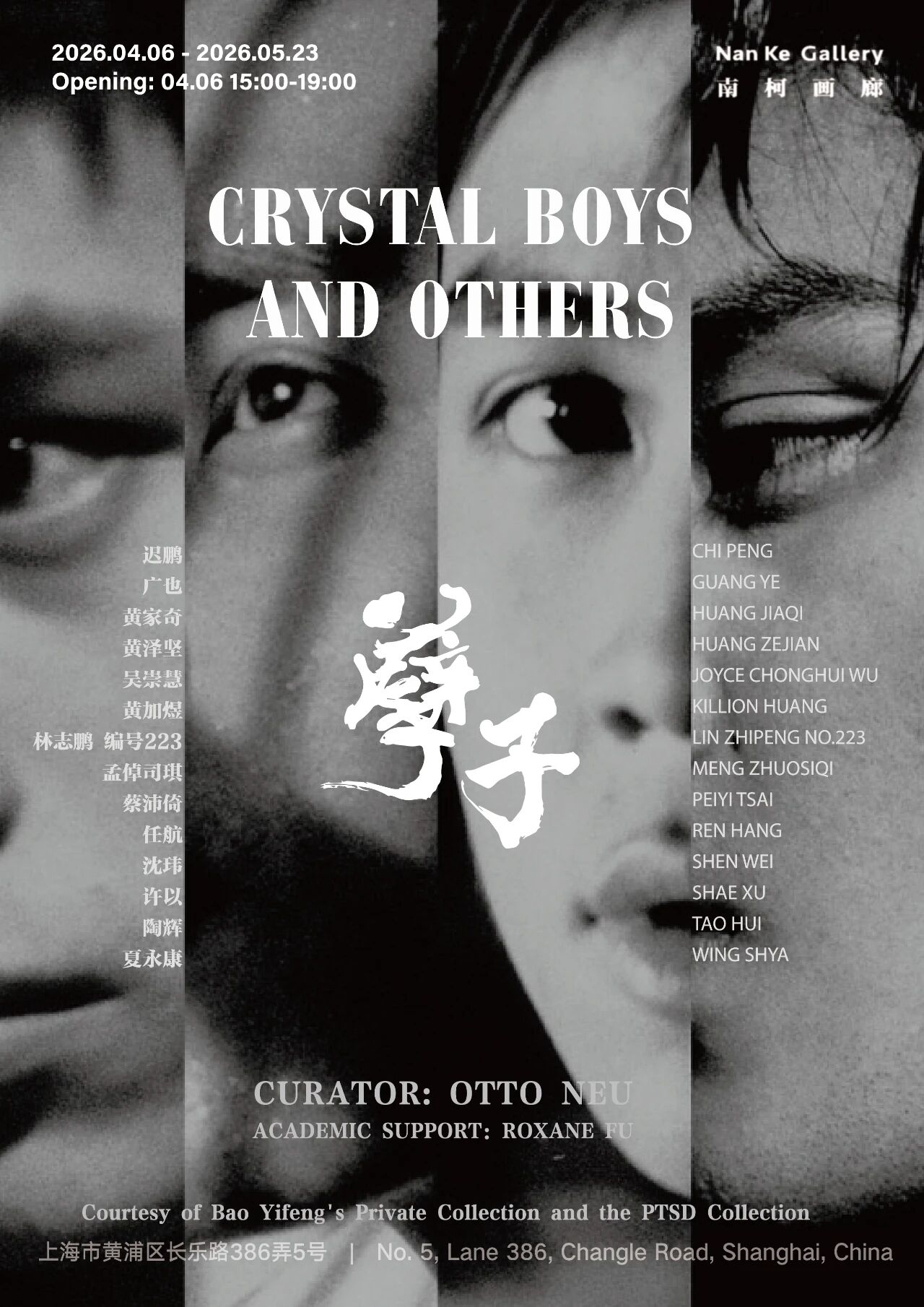
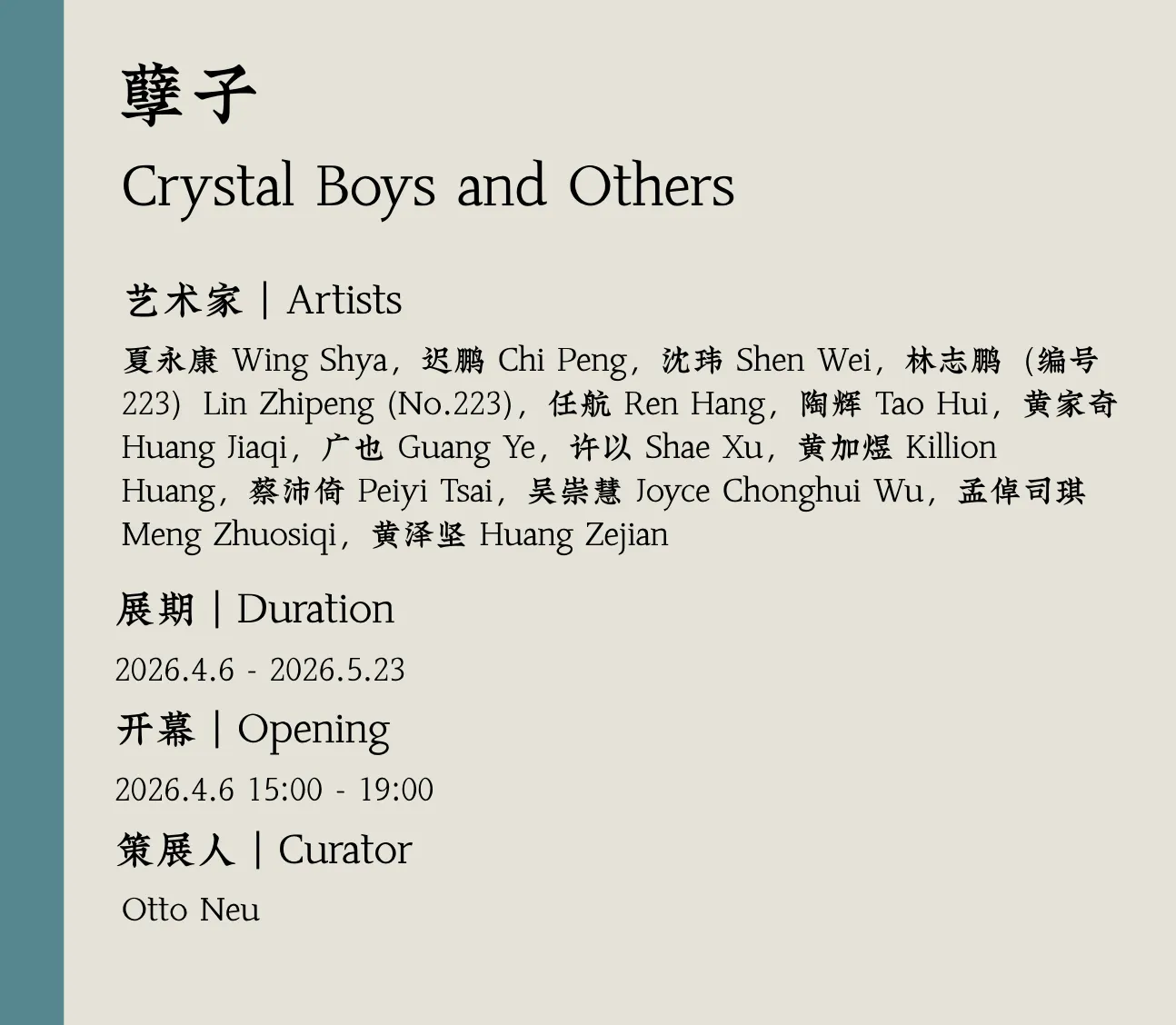

Nan Ke Gallery is pleased to present the exhibition project Crystal Boys and Others, a romantic homage to queer art in Chinese context. The exhibition brings together a selection of artists who, from the 1990s to the present, have engaged the queer community as a central subject of their practice. Participating artists include Wing Shya, Chi Peng, Shen Wei, Lin Zhipeng (No.223), Ren Hang, Tao Hui, Huang Jiaqi, Guang Ye, Shae Xu, Killion Huang, Peiyi Tsai, Joyce Chonghui Wu, Meng Zhuosiqi, and Huang Zejian.
The exhibition takes its title from Crystal Boys, the novel by Pai Hsien-yung. Widely regarded as the first work in the Chinese-speaking world to openly depict the lives, emotions, and struggles of the queer community, the novel broke through the social taboos of its time, bringing a once-hidden marginalized group into the field of mainstream literature. The exhibition follows the novel’s tripartite framework of identity, patriarchy, and Buddhist thought.
The narrative of Crystal Boys unfolds in the nighttime of a park in the 1970s—a group of young men, cast out by family and social order, struggle and love at the margins of the city, sustaining themselves through the exchange of their bodies. Marked by the label of “sin,” they drift in territories beyond the reach of daylight, while forming another kind of hidden community through mutual gaze and dependence.
In parallel, this narrative reflects the historical trajectory of queer art: from a long period of concealment and voicelessness within non-mainstream cultural structures, to its gradual emergence into public discourse and institutional visibility in recent years. This movement from the margins toward visibility is not merely a revelation of identity, but a rewriting of narrative agency, bodily politics, and affective structures.
Time, within this exhibition, does not unfold linearly but occurs simultaneously. As repeatedly suggested in Crystal Boys through notions of causality and past lives, the past and the future coalesce to form the present. In looking back at the works and individuals that have emerged over the past three decades, one might ask: is queer art a phenomenon, or evidence of another mode of life? Through the exhibition’s four chapter-like dialogues, we attempt to trace possible responses to this question.

At the opening of the exhibition, artists Wing Shya and Xu Yi present the body as a sincere offering before the viewer. Bodily imagery was among the earliest forms through which queer art first emerged. Its point of departure lies less in identity than in the body itself—through which questions of taboo, boundary, and existence are explored. This marks the initial condition of queer artistic expression. It echoes the figures in Crystal Boys, cast out by family and paternal authority, moving toward lives shaped by exile.
Though approaching the body from distinct subject positions—male and female—Wing Shya and Xu Yi articulate, through a shared visual language, the stance and energy conveyed by the body as object. The body is not merely a vessel of flesh and bone, nor simply a trigger for desire. When it becomes an expression of identity and belief, the tensions of being seen and being tacitly permitted reverberate with a quiet yet resounding force.
In Wing Shya’s collage Happy Together #1 (1997), the bodies of the film’s protagonists are presented in an almost unguarded state at the margins of the city: two intertwined figures lie horizontally on a rooftop, with the blurred skyline and low-rise buildings of Buenos Aires stretching into the distance. There is no clear narrative, nor any stable sense of belonging—only a fragment of intimacy, suspended in time. Desire is exposed within an open yet unacknowledged space, hinting at the condition of exile in which the two figures, displaced to the other side of the world, can find fleeting warmth only through each other’s bodies.
The question of female desire and its constraints has been a recurring concern in Xu Yi’s practice. In Gap (2016), the image of a “burning bathtub” serves as an intensified metaphor for this condition. Within a patriarchal framework, femininity has long been defined through the qualities of water—softness, fluidity, and fertility—while female desire itself has been persistently overlooked. As flames surge within water, and as both desire and vulnerability are brought into view, these seemingly opposing elements converge into a reflective image of the dilemmas faced by women today. Here, the artist transforms the body into a sign of exile; through its prolonged tension with inherited values, “being seen” becomes a form of evidence for existence itself.
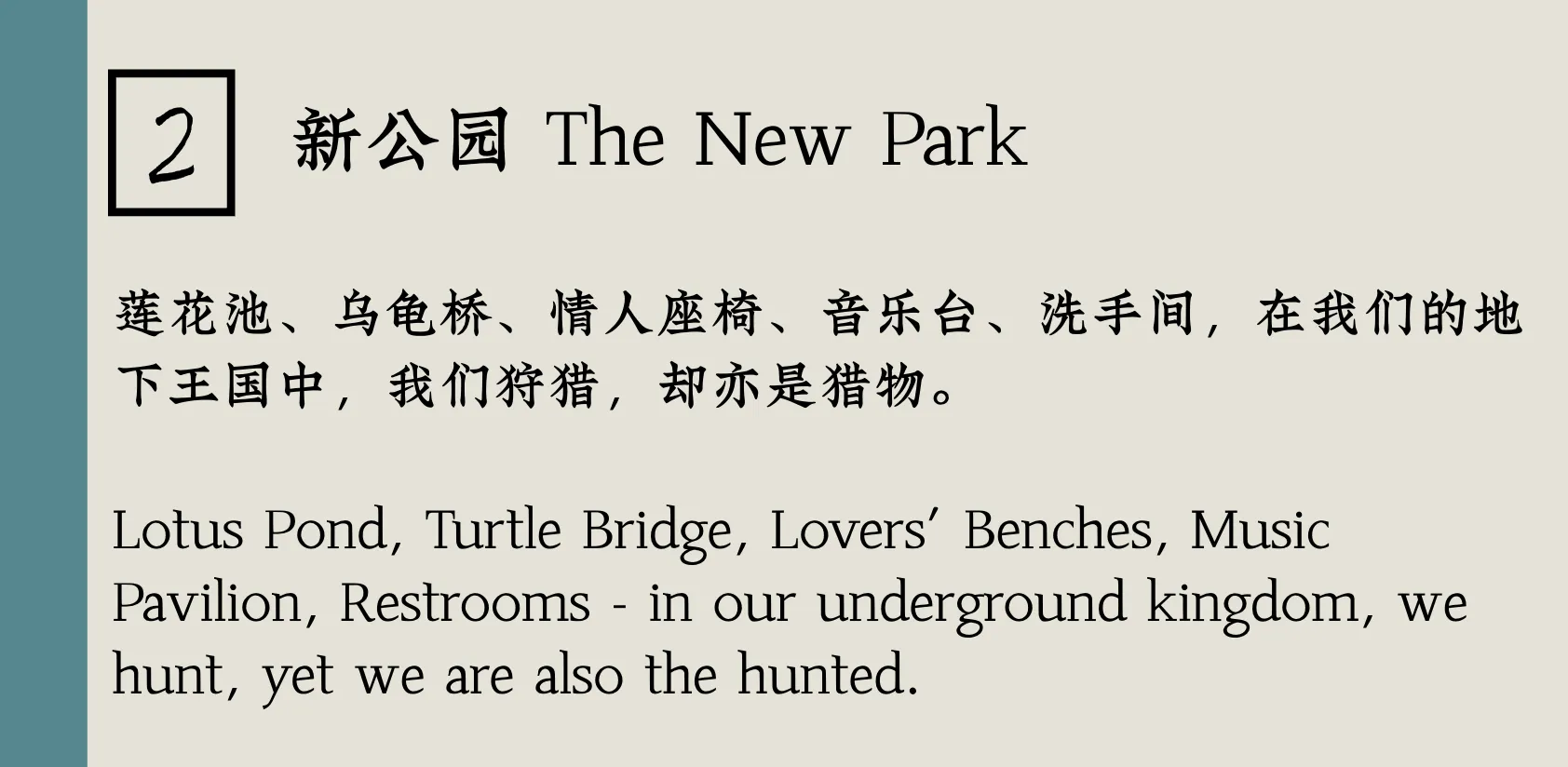
In Crystal Boys, the “New Park” carries a deeply layered symbolic meaning: it is at once a public space and an underground kingdom. It allows the “boys” to find one another, yet simultaneously exposes them to the constant risk of humiliation, interrogation, and even arrest. For the queer community of that time, the park was far from a safe haven; rather, it was an absurd terrain in which one had to continuously negotiate with the police and a wide array of social forces. Within this space, a dramatic “hunting relationship” emerged between queer subjects and the structures of patriarchy.
Yet no one remains the prey forever. When Lin Zhipeng (No.223)’s Tiger’s Peeking (2019) is enlarged and placed across an entire wall, the lover’s gaze—emerging from between a pair of legs—meets the viewer directly, drawing them, almost unconsciously, into a mechanism of looking. The viewer becomes the one being looked back at, being examined. This inversion of vision disrupts the safe distance of observation, making one aware that they, too, are subject to a form of disciplined scrutiny. Here, the gaze loses its fixed position, and the roles of hunter and hunted are reversed.
This dynamic of looking is further extended in Meng Zhuosiqi’s work. In the video piece There are no words between us (2023), the sustained eye contact between two women constructs a temporal structure that is both slow and intense. The flicker of an electric fly swatter, like the flash of a camera, transforms a fleeting instant into a recordable event. In this way, ten seconds of exchanged gaze is prolonged into a state that feels almost suspended—nearly still, yet enduring.
On the other side of the space, Huang Jiaqi’s My Body is a Cage 1 (2021) enters this structure in a more concealed manner. When the mouth becomes a lotus pond and fish drift within it, acts of swallowing, breathing, and silence unfold within the same space. Here, “seeing” no longer relies on the eyes, but shifts toward a deeper bodily experience: can language truly carry desire? Can silence itself be a form of enforced expression?
Within this field, Lima (2013) continues Shen Wei’s exploration of the tension between bodily intimacy and urban space. The artist’s self-image, as presented in the work, is observed and framed within the city; he is both part of the urban landscape and, at the same time, remains an individual presence that resists definition and defies belonging. One seems unable to step outside this structure.
Guang Ye likewise takes the male body as a point of entry. His close-up fragments expose details that would typically belong to the private realm, bringing them into the domain of visibility. Such exposure is at once candid and precarious—it invites looking, while simultaneously questioning it. Under these conditions, does the act of looking itself become a form of intrusion?
When identity and roles lose their fixed labels, they emerge, shift, and dissolve within the crossing of gazes—only to be reconstituted through pursuit and escape. In that park, desire is able to take place, and identity, in turn, comes into being. The New Park in Crystal Boys never truly belongs to anyone, yet it is reclaimed anew each night. The multiple oppositions of “sin and punishment,” “shelter and expulsion” form the fundamental order of this space.
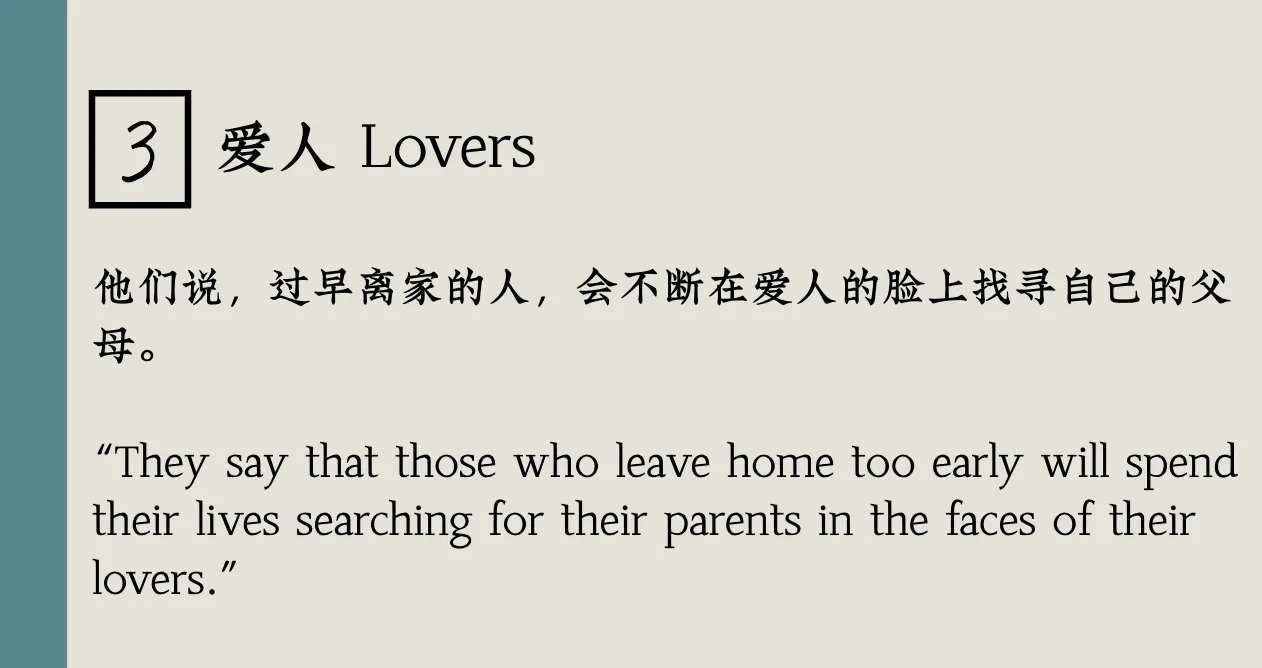
Within the narrative structure of Crystal Boys, the Buddhist notion of karma forms an essential underlying rhythm. Whether it is A-qing, cast out by his father yet endlessly searching for a sense of “home,” the young men who wander the park each night in search of a stranger’s fleeting warmth, or the “boys” who attempt to enter the “normal” world only to be repeatedly rejected by it—these cycles without exit collectively shape the novel’s understanding of love, desire, and recurrence. Yet while Buddhist samsara is governed by karma, the narrative of Crystal Boys unfolds as a cycle driven by love and desire.
This chapter brings together the works of two female artists, who quietly explore the “surface” and “interior” of intimate relationships. Unlike earlier generations, their perspectives no longer take a specific queer identity as a prerequisite, nor do they point toward a fixed context. Instead, they pose questions to the viewer through the fundamental conditions of intimacy itself. Within Buddhist thought, desire is often understood as a form of trial. The parts of our personality and spirit that remain unresolved are frequently amplified through the oscillations and negotiations of close relationships. Though desire and love may appear similar, they are, in essence, fundamentally different propositions.
Peiyi Tsai approaches her work from a delicate perspective rooted in Asian queer female experience. She gently captures fleeting moments—the curve of an ear, the pause of a gaze, a ring resting on a finger—and condenses them into images that can be held and seen. Through this, intimacy quietly enters the realm of the everyday, and these subtle details become a way of preserving and cherishing love.
In Joyce Chonghui Wu’s mixed-media series Proof Bag: Official Vid 1: Love (2025), “love” is treated as something that can be collected, dismantled, and reassembled as evidence. A line from a letter written by her partner—“my lover is a square patch of blue”—is fragmented, reconstructed, and embedded across different fabric structures within the series. Memory here is no longer a linear narrative; its fragments are pieced together into a composite whole of affection. Yet when emotion is translated into objects, and language compressed into remnants, can intimacy still be fully understood? Or is love, by its very nature, destined to exist only in incomplete forms.

n the world of Crystal Boys, those boys never truly leave the park. Nor do they arrive at a complete relationship, let alone a stable identity; instead, they drift endlessly within the cycles of karma. As newcomers replace those who came before, and the desires of the night repeat themselves, relationships are constantly formed and dissolved. What once seemed like a question bound to a particular historical moment now appears, on the surface, to have passed—yet it persists among us in altered forms. Today, the park is no longer merely a physical site; it has become a condition of disorientation within a paradigm of freedom. When freedom is attained, what comes next?
At the moment when Eve and Adam gained the clarity brought by the fruit of knowledge, did they see Eden as a beautiful and tranquil home, or as a place of confinement? We cannot know. What we do know is that, alongside disorientation and suffering, human civilisation began from that very instant. The questions explored in this chapter thus enter a more complex temporal structure: identity is continually rewritten within the course of history, the boundaries between freedom and constraint shift and transform, and past and future unfold simultaneously in the present moment.
Within this condition of multiple temporalities, Huang Zejian extracts, combines, and reconfigures individual identities, weaving them into his installation series Untitled No. 88 (2019). Beginning with the skin of strangers encountered on the social app Tinder, he scans bodies, processes images, and incorporates sewing, transforming “skin” into a surface that can be replicated and reassembled. Echoing this process is the memory of the artist’s mother, who worked as a textile laborer in his childhood—her threads traverse time and reappear within the work. In this way, personal experience is translated into a new narrative form, while the bodies sourced from Tinder are, in turn, rendered into a kind of enduring, almost immortal presence.
In Chi Peng’s Binding Myself (2022), the presence of the body is rendered through a classical aesthetic, placing it in a state where idealization and theatricality coexist. Unlike the heroic narratives of the body in ancient Greek tradition, the figure here carries a distinct sense of provocation—desire is no longer concealed, but directly asserted as a force. The classical is no longer merely historical; it becomes a vessel for contemporary desire. Ren Hang’s photography, by contrast, returns the body to a mode of direct and disarming presentation. In Untitled (2012), a hand extends through the space beneath a man’s body, leaving only the back view of the hips and a suspended sense of weight within the frame. Humor and unease intertwine here: the body is at once an object of desire and a symbol subject to deconstruction.
In Tao Hui’s photographic work Leng Shuihua Youth Age (2018), history itself is thoroughly destabilized. Through the fictional text A History of Southern Theatre, he constructs a narrative system that hovers between reality and fabrication: memory, hearsay, and personal experience intertwine, allowing history to shed its authoritative status and instead become a structure open to continual retelling and rewriting. In this sense, the act of “leaving the park” never truly occurs—it merely shifts into another, more concealed mode of narration, where it continues to persist.
Killion Huang’s paintings, by contrast, draw attention back from history to the realm of everyday relationships. Taking the queer communities around him as his point of departure, he captures those elusive moments within light and space that resist clear definition. His figures are at once specific and indeterminate, their presence drifting across gender, temperament, and social labels. Within his work, queerness ultimately ceases to function as an identity that demands recognition, and instead becomes a naturally emergent state—a mode of being that requires no explanation.
Looking across the works in this exhibition—each emerging from different eras, perspectives, and identities—we return once again to the central question: within the Chinese literary context, is queer art merely a phenomenon, or is it evidence of another form of life? I would argue that “love” itself is its only true definition.
Pai Hsien-yung defines “nie” not as a moral sin, but as an inescapable human condition—an entanglement of obsession and fate, a state in which individuals continuously struggle between love, desire, and belonging. It is precisely in this sense that Crystal Boys gives rise, within darkness, to a profound humanistic light: a courage to seek understanding and love even from within a place of exile.
At this moment, whether one can “leave the park” is perhaps no longer a question that can be answered. It becomes instead a possibility in constant circulation and renewal: bodies continue to be seen, relationships continue to form, and the history of queer art continues to be written. Only now, all of this no longer unfolds within the same night, nor within the same park.
Text: Otto Neu