“Les règlements ne sont établis que pour assurer l’exécution des actions.”
—— Les 120 journées de Sodome
Nan Ke Gallery is pleased to announce that the exhibition project The 120 Days of Sodom will open on January 10, 2026. The exhibition brings together works by artists Gaojie Chen, Lindong Duan, Yujian Guo, Michael Gao, Dehua Hou, Tianyu Huang, Xiaozhou Liao, Xipeng Qiu, Muhan Wu, Lingrou Xie, and Pengfei Zai. Within the exhibition’s thematic framework, these artists are connected through a shared engagement with classical paradigms—yet it is precisely within the subtle fissures of these inherited forms that human desire and impulse awaken, generating a sharp and compelling tension.
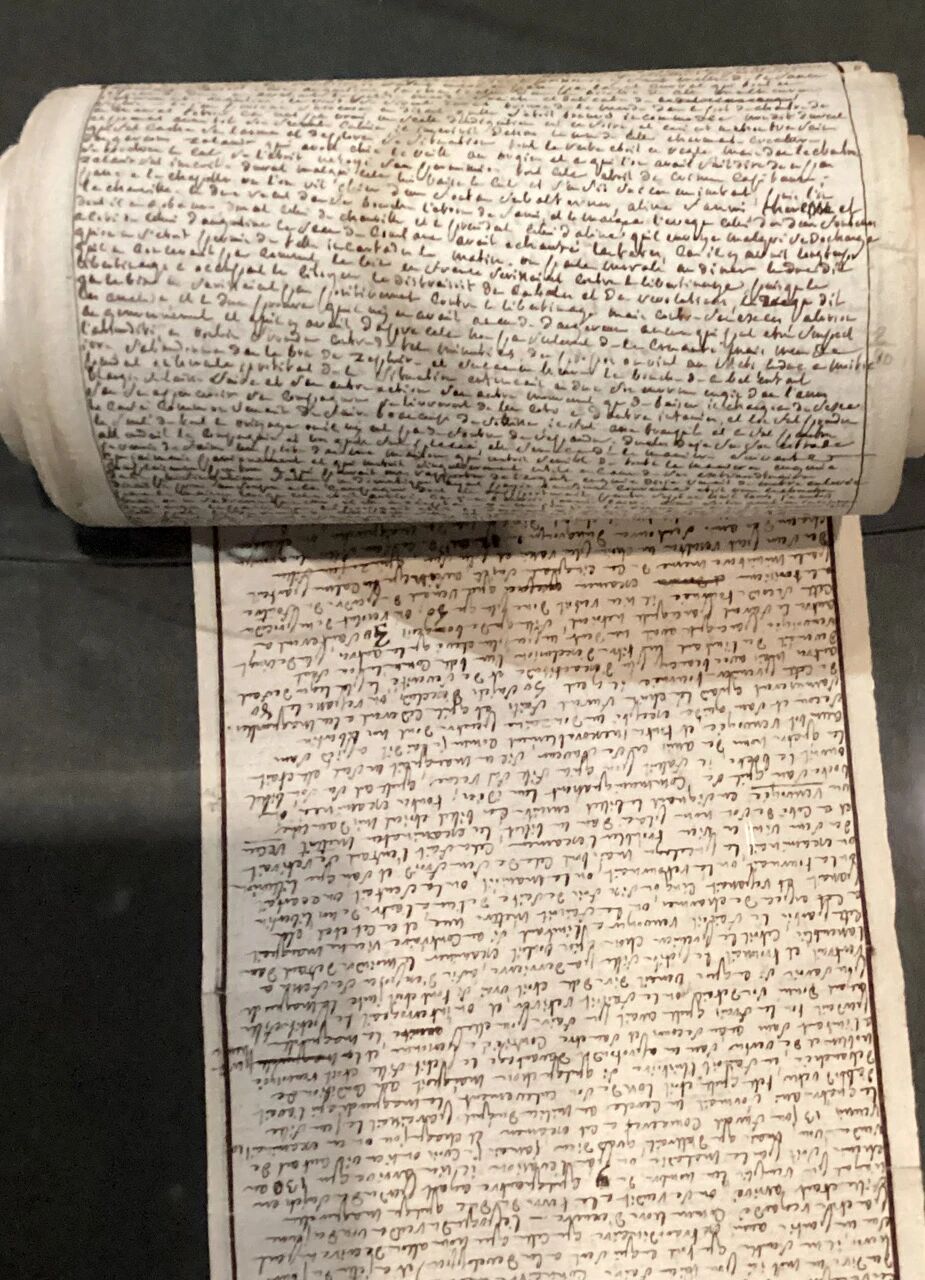
Detail of Marquis de Sade’s manuscript Les 120 journées de Sodome ou l'école du libertinage, photo by Joseph Nechvatal
The 120 Days of Sodom (Les 120 journées de Sodome) is a long-form novel written by Marquis de Sade in 1785 during his imprisonment in the Bastille. Notorious for its violent and seemingly vulgar narrative, the work stands in stark contrast to the rationalism of the Enlightenment, probing deeply into the complexities of human nature beneath the surface of desire and power. Its first publication in the early twentieth century sparked intense controversy. Sade’s lifelong resistance to social convention—his pursuit of a kind of “purity”—has made him a symbol hovering at the boundary between reason and madness, good and evil. As Simone de Beauvoir famously noted, “We must not burn Sade, for it is because of his rebellion.”
The singular place that The 120 Days of Sodom occupies in literary history lies not merely in its extremity or libertine excess, but in its brutal illumination of the darkness beneath Enlightenment rationality. Sade employs the outward structure of the classical narrative only to carve out a fundamental critique of civilized order—transforming literature into an act of revolt. This intense resistance against power, morality, and normativity resonates strongly with the core of contemporary sensibilities: today’s artists persistently return to classical languages not as sacralized rules to obey, but as materials to tear open, rewrite, and disrupt. What they seek within classical forms aligns with what Beauvoir described as rebellion: a method of re-inscribing the chaos and desire of the modern condition into the textures of history.

Xiaozhou Liao
The Spurs, 2025
Stainless steel shoe armor, knight boots, roller skates, cowhide soles
50h x 50w x 40d cm
© Courtesy of the artist
The exhibition unfolds across four independent spatial levels, echoing the novel’s structure of “four sequences of thirty days,” and extending Sade’s four-act architecture. As visitors ascend through each floor, the classical paradigm becomes increasingly complete and formally coherent—yet the emotions and reflections embedded within grow more closely aligned with contemporary urgencies, moving toward intimacy, unease, and vulnerability.
As in the novel’s cyclical progression of “four seasons,” “the rules tighten, yet expression becomes increasingly unrestrained.” Under constraint, rational thought, turbulent emotion, primal desire, and the pull of spiritual belief erupt simultaneously. This dynamic mirrors the Renaissance and Neoclassical revivals of Greco-Roman forms, revealing a humanism that is distinctly contemporary.
Yujian Guo
Perseus and Medusa, 2025
Oil on canvas
120h x 80w cm
© Courtesy of the artist

The dimly lit room signals the origin of everything. Antique books, once solemnly displayed beneath cascading drapery, open the prelude to inquiry. Below them, a pair of meticulously arranged metal knight’s sabatons invites the imagination to conjure the ghostly presence of the Marquis de Sade standing at the threshold. Nearby, a painting echoes this classical staging: layers of finely rendered curtains unfold in axial symmetry, amplifying an atmosphere of precision and monumental classicism. Yet the wheels affixed to the sabatons, along with the grids and unnatural geometric forms embedded within the painting, gesture toward another dimension beneath the façade—hinting at the emergence of modern traces under the weight of classical rule.

Pengfei Zai
Motion Sickness Pills 30.6, 2023
Charcoal and acrylic on paper
140h x 140w cm
© Courtesy of the artist

Lingrou Xie
A Slow Returning Tide, 2025
Oil on canvas
60h x 50w cm
© Courtesy of the artist

Ascending the steps, the next space unmistakably weaves an atmosphere charged with the impulses of the flesh. Expanses of exposed skin overlap one another, depicted from a low, upward gaze—as if heroes poised to draw their swords amidst towering mountains. A monumental chandelier hangs at the center, yet the spaces meant for candles have been replaced by artificial objects used in the alteration of biological sex, forming a simulated cycle of lunar phases.
A painting of a similarly grand chandelier responds to this gesture, though its presence is no longer solemn; instead, it hovers almost surreally close to the ground, framing an ordinary man whose face remains unseen beside a dog of striking athletic build. In the corner framed by Roman columns, two triptychs stand in mirrored dialogue. Arched three-dimensional structures divide the fluttering movement of birds from the fossil of a nautilus, while a star-studded backdrop—reminiscent of medieval painting—offers metaphors related to reproduction.

Muhan Wu
The Nun, 2025
Comprehensive material
300h x 85w x 85d cm
© Courtesy of the artist

Michael Gao
Sneaking Out Before Dessert, 2025
Acrylic on canvas
70h x 60w cm
© Courtesy of the artist
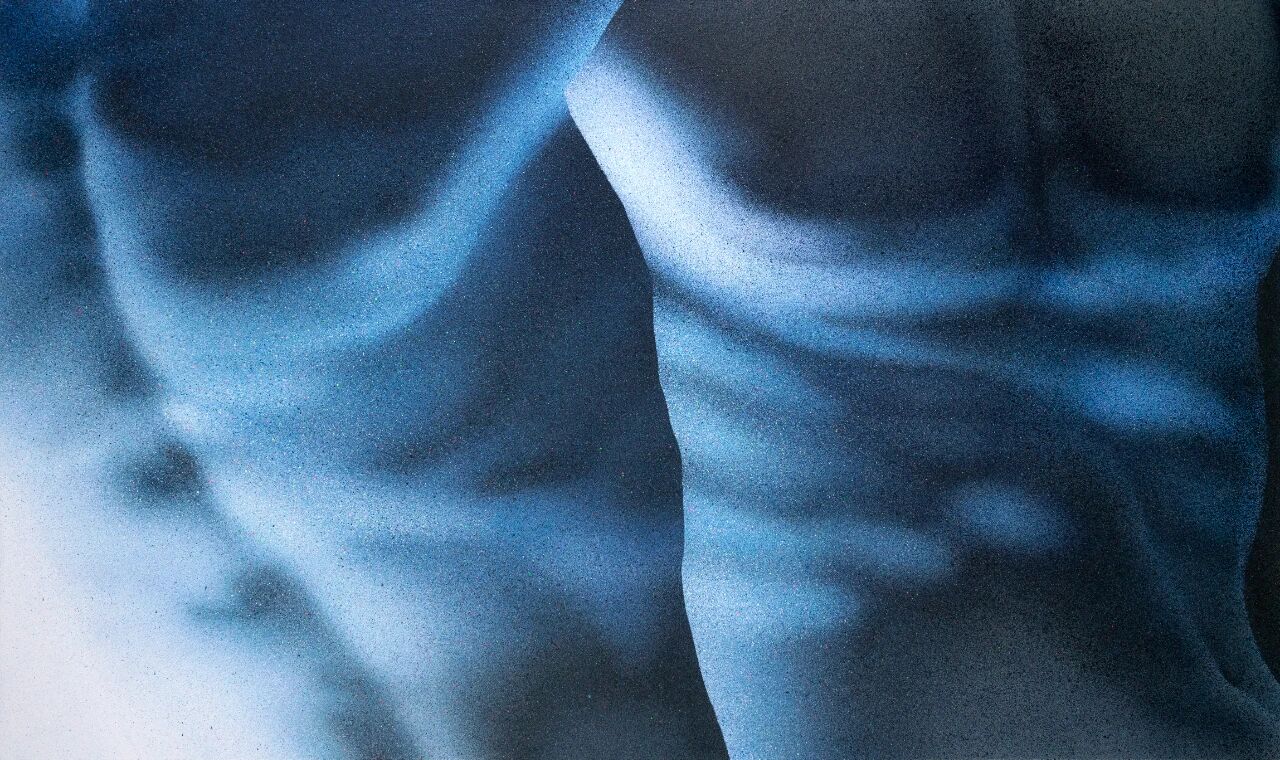
Dehua Hou
Face Unknown, Body the Same, 2025
Acrylic on dew retting flax
83h x 140w cm
© Courtesy of the artist
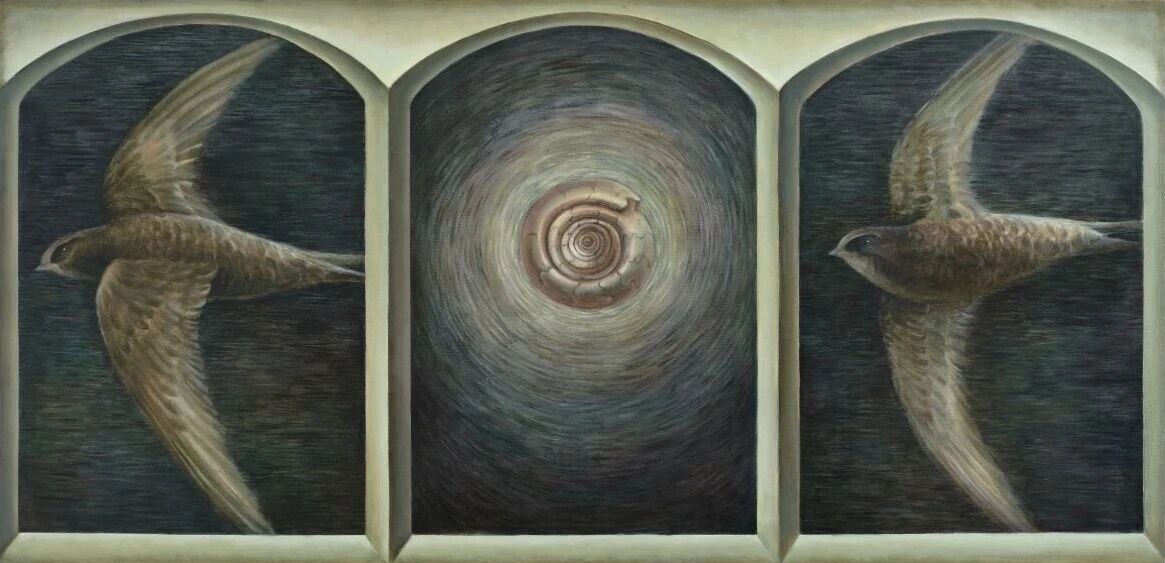
Tianyu Huang
Return in Rotation, 2025
Oil on canvas
62h x 128w cm
© Courtesy of the artist

The theme of the flesh continues, becoming more entangled and intimate. Hands, torsos, and limbs seem to blur and melt into one another, only to be pierced by enormous blades—aggressive, sharp-edged forms that cut clean divisions into the structure of light and shadow. Opposed to these rational delineations is a haze of intense interior emotion: above an ouroboros, flames roar upward, allowing desire to proliferate across an infinite expanse of time.

Dehua Hou
War Memorial:△ 1-3, 2023
Acrylic on dew retting flax
90h x 60w cm x 3 pic
© Courtesy of the artist
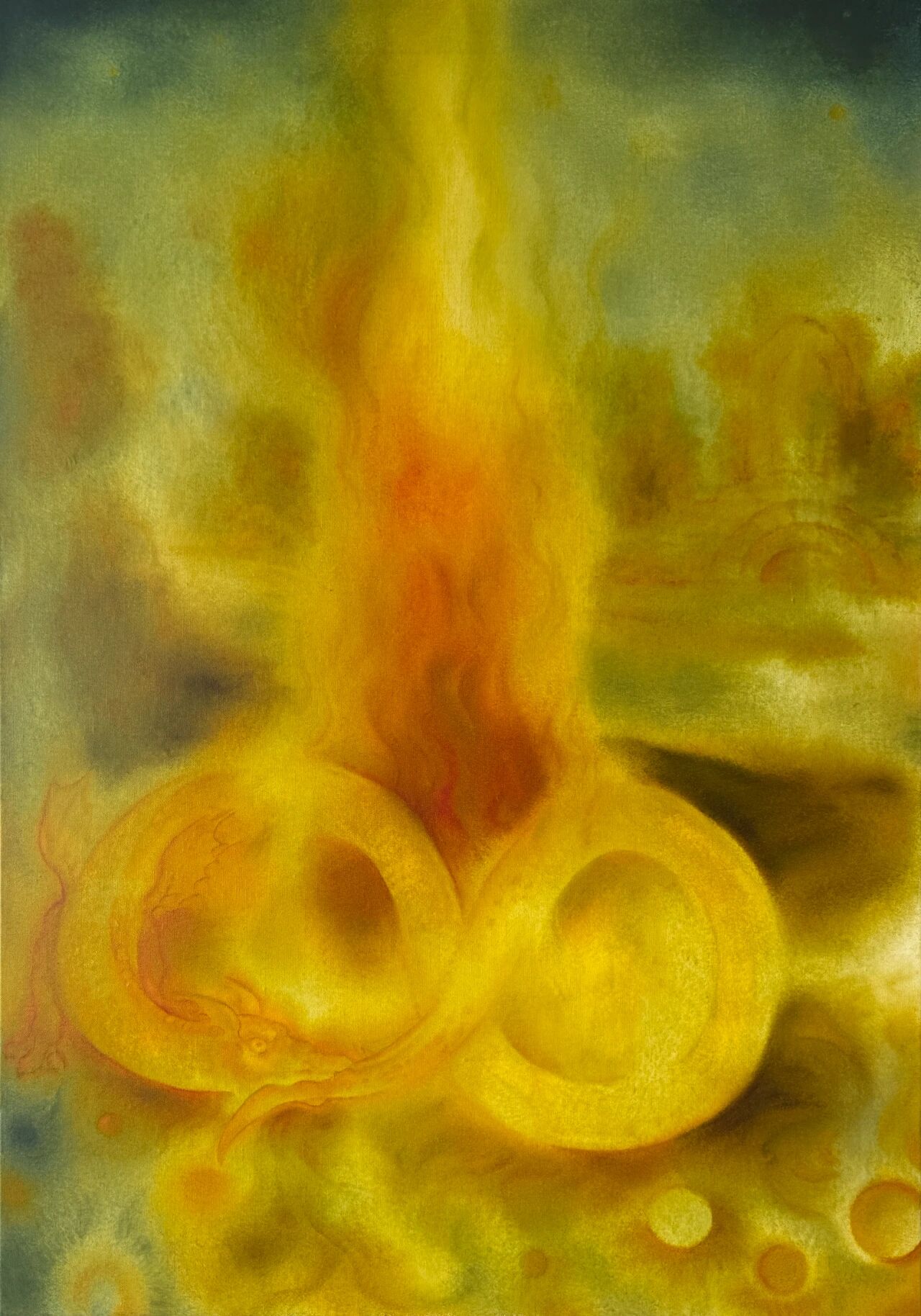
Yujian Guo
Ourboros, 2025
Oil on canvas
100h x 70w cm
© Courtesy of the artist

At the topmost level, the room announces an extreme final act. The fountain—an emblem of the origins of the city-state and of civilization—suggests renewal and transmission through its flowing water. Beneath a pointed stained-glass window, the meticulously rendered architectural interior directly echoes the narrative of Sodoma. Figures flicker in and out; chaos and order reach their simultaneous peak, forming a precision engine driven by desire.
On both sides, mirrored archways recall the laws of the physical world, aligning themselves with the rise of the moon and the setting of the sun—symbols of the spiritual realm. A solitary eye echoes a pair of clasped hands, merging the classical “lover’s eye” with gestures of devotion. Mythological narratives are rewritten here, arriving at a grand conclusion in a state of perpetual motion.

Xipeng Qiu
Myth, 2025
Tempera on wood panel
46h x 40w cm
© Courtesy of the artist

Pengfei Zai
Motion Sickness Pills 40.0, 2024
Charcoal and acrylic on paper
100h x 140w cm
© Courtesy of the artist

Lindong Duan
Ten-Finger Mountain II, 2025
Tempera on wood panel
40h x 20w cm
© Courtesy of the artist
The 120 Days of Sodom seeks to offer another perspective on classical paradigms within contemporary art. For the artists in the exhibition, the classical canon functions not merely as a historical reference, nor as a habitual imitation of the sublime and the idealized image. Rather, it is within the constraints of such a paradigm that fissures open—cracks through which something other, something irretrievable in a state of absolute freedom, can emerge.
The exhibition brings together eleven artists who reinterpret and transform classical paradigms through diverse contemporary practices. Gaojie and Michael employ meticulous painting to articulate classical perspectives and opulent imagery. Yujian and Tianyu extend the language of traditional narrative, depicting heroic myths, birds in flight, fossils, and botanicals. Dehua explores the human body suspended between rationality and divinity, while Lindong and Xipeng capture emotional turbulence through compositions that magnify and isolate bodily fragments.
Lingrou constructs a dual narrative, searching for moments where timelines fold into one another. Pengfei utilizes disciplined, physically grounded imagery to evoke ancient and enduring philosophical sensibilities. Meanwhile, installation artists Wu and Liao deconstruct the significance of the objet trouvé, extending the spiritual potency of “the object” within a contemporary context.

Gaojie Chen
The Divine Purge Palace, 2025
Oil on Canvas
120h x 72w cm
© Courtesy of the artist
Kristeva’s notion of the abject may well affirm a core dimension of contemporaneity: before any system of beauty is constructed, the abject is already there, waiting. The abject is the portion that order can never fully consume—vast, unsettling, and charged with terrifying force. In each return to the classical, every pilgrimage toward inherited forms, the traits of our present era collide with these long-standing paradigms, generating new tensions that propel artistic spirit and creative radiance forward.
This aligns precisely with the spirit of humanism: that once one confronts and depicts humanity with unguarded honesty, it becomes clear that the tension between rules and freedom is not merely a sociological conflict, but a paradox inherent to human nature itself. In submitting to structure, it is precisely within the cracks and shadowed intervals that a more absolute freedom—and even a kind of fervor—begins to grow. As the Marquis de Sade ultimately wrote, “We establish rules for everything, yet we can never command where things will go.”
Text by Roxane Fu


