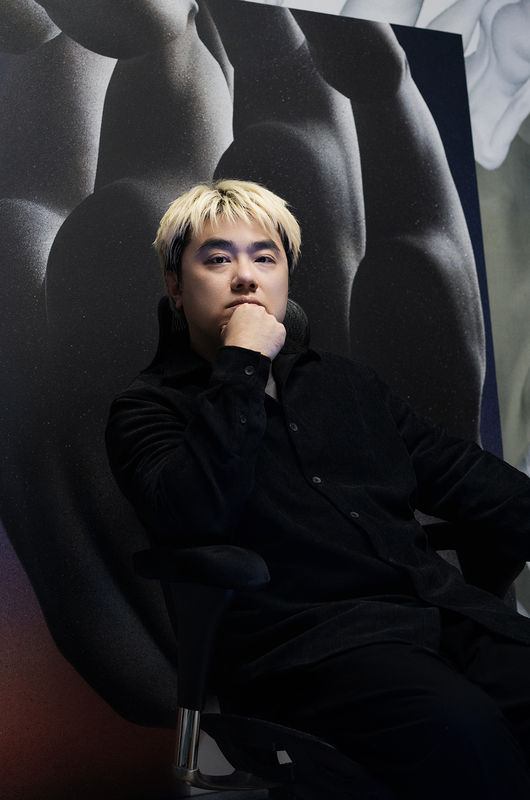
Dehua Hou’s recent works are rooted in his personal life experiences, exploring the perception of reality and the nature of existence. As a person with Visual Snow Syndrome, his art is deeply influenced by this condition, reflecting his unique perception of both the visual and mental worlds.
For patients with Visual Snow, the world appears covered in a dense array of “noise,” resembling the static of a television screen with no signal. This condition is relatively common but lacks effective treatment methods. It is believed to originate in the brain rather than the eyes, and is often linked to unexplained psychological trauma. Visual Snow has become a path into the mental world through visual representation, where the “noise” plays a significant role in shaping both form and technical expression.
In his works, overlapping gray and white bodies present the decay of the physical form (Soma Vessel, 2023). These models, lacking thickness, reveal their internal structure as the point of observation shifts, causing the boundaries of virtual space to disappear (Roaming, 2024). Terms like “wearing through the model” and “internal observation points,” foundational in the 3D world, gradually dissolve the solidity of materiality. The “body” reconstructs order in a purposeless, indistinct state.
Education
2018 MFA, School of Experimental and Sci-Tech Arts, Central Academy of Fine Arts, Beijing
2013 BFA, Sculpture Department, Luxun Academy of Fine Arts, Shenyang
Solo Exhibitions
2017 Toxic, China International Exhibition Center, Beijing
Selected Group Exhibitions
2025 Escapology of Flesh, ART LABOR Gallery, Shanghai
2025 The Walkers Narrative, Bao‘an 1990 Art Museum, Shenzhen
2023 Group as a Method: Research and Samples of Art Groups 2023 from Central Academy of Fine Arts, CAFA Art Museum, Beijing
2017 Invasion of Brain Stem Plan, Yang Gallery, Beijing
2016 Moments and More: Documents of Culture Pavilion [wén huá guǎn] Online Art Project, OCAT, Shanghai
2016 Turning Point: Contemporary Art in China Since 2000, Shanghai Minsheng Art Museum, Shanghai
2016 Kezikeshe: 666666666, Cipa Gallery, Beijing